Tirukkannapuram Vijayaraghavan
Indian mathematician (1902–1955)
From Wikipedia, the free encyclopedia
Tirukkannapuram Vijayaraghavan (Tamil: திருக்கண்ணபுரம் விஜயராகவன்; 30 November 1902 – 20 April 1955) was an Indian mathematician from the Madras region. He worked with G. H. Hardy on Pisot–Vijayaraghavan numbers when he went to Oxford in the mid-1920s. He was a fellow of Indian Academy of Sciences elected in 1934. His father was a pandit.
Thirukannapuram Vijayaraghavan | |
|---|---|
| Born | 30 November 1902 |
| Died | 20 April 1955 (aged 52) |
| Occupation | mathematician |
Vijayaraghavan was well-versed in Sanskrit and Tamil. He was a close friend of André Weil. Weil hired him in 1930 despite his lack of diploma, and they served together in Aligarh Muslim University.[1] While Weil was away in Europe, Ross Masood planned to replace Weil's professorship with Vijayaraghavan, but Vijayaraghavan quit in protest and moved to the University of Dhaka.[2]
Vijayaraghavan proved a special case of Herschfeld's theorem on nested radicals:[3] For

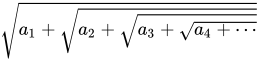
converges if and only if

where denotes the limit superior.


