Titanium biocompatibility
From Wikipedia, the free encyclopedia

Titanium was first introduced into surgeries in the 1950s after having been used in dentistry for a decade prior.[1] It is now the metal of choice for prosthetics, internal fixation, inner body devices, and instrumentation. Titanium is used from head to toe in biomedical implants. One can find titanium in neurosurgery, bone conduction hearing aids, false eye implants, spinal fusion cages, pacemakers, toe implants, and shoulder/elbow/hip/knee replacements along with many more. The main reason why titanium is often used in the body is due to titanium's biocompatibility and, with surface modifications, bioactive surface. The surface characteristics that affect biocompatibility are surface texture, steric hindrance, binding sites, and hydrophobicity (wetting). These characteristics are optimized to create an ideal cellular response. Importantly, patient condition can influence the type of modification necessary, for instance in patients with steatotic liver diseases other titanium surface modifications provide better outcomes as compared to patients without fatty liver disease.[2] Some medical implants, as well as parts of surgical instruments are coated with titanium nitride (TiN).
Osseointegration interaction and proliferation
Titanium is considered the most biocompatible metal due to its resistance to corrosion from bodily fluids, bio-inertness, capacity for osseointegration, and high fatigue limit. Titanium's ability to withstand the harsh bodily environment is a result of the protective oxide film that forms naturally in the presence of oxygen. The oxide film is strongly adhered, insoluble, and chemically impermeable, preventing unfavorable reactions between the metal and the surrounding environment.[3]
High energy surfaces induce angiogenesis during osseointegration
It has been suggested that titanium's capacity for osseointegration stems from the high dielectric constant of its surface oxide, which does not denature proteins (like tantalum, and cobalt alloys).[4] Its ability to physically bond with bone gives titanium an advantage over other materials that require the use of an adhesive to remain attached. Titanium implants last longer and much higher forces are required to break the bonds that join them to the body compared to their alternatives.[5]
Surface properties determine osseointegration
The surface properties of a biomaterial play an important role in determining cellular response (cell adhesion and proliferation) to the material. Titanium's microstructure and high surface energy enable it to induce angiogenesis, which assists in the process of osseointegration.[6]
Surface energy
Redox potential
Titanium can have many different standard electrode potentials depending on its oxidation state. Solid titanium has a standard electrode potential of −1.63 V. Materials with a greater standard electrode potential are more easily reduced, making them better oxidizing agents.[7] As can be seen in the table below, solid titanium prefers to undergo oxidation, making it a better reducing agent.
| Half reaction | Standard electrode potential (V) |
|---|---|
| Ti2+ + 2 e− → Ti(s) | −1.63[7] |
| Ti3+ + 3 e− → Ti(s) | −1.21[8] |
| TiO2 + 4 H+ + 4 e− → Ti(s) + 2 H2O | −0.86[9] |
| 2 TiO2(s) + 2 H+ + 2 e− → Ti2O3(s) + H2O | −0.56[9] |
| Ti2+(aq)/M3+(aq) | −0.36[8] |
Surface coating

Titanium naturally passivates, forming an oxide film that becomes heterogeneous and polarized as a function of exposure time to bodily environments.[10] This leads to the increased adsorption of hydroxyl groups, lipoproteins, and glycolipids over time.[10] The adsorption of these compounds changes how the material interacts with the body and can improve biocompatibility. In titanium alloys such as Ti-Zr and Ti-Nb, zirconium and niobium ions that are liberated due to corrosion are not released into the patient's body, but rather added to the passivation layer.[11] The alloying elements in the passive layer add a degree of biocompatibility and corrosion resistance depending on the original alloy composition of the bulk metal prior to corrosion.
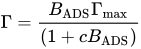
Protein surface concentration, (), is defined by the equation

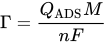
where QADS is the surface charge density in C⋅cm−2, M is the molar mass of the protein in g⋅mol−1, n is the number of electrons transferred (in this case, one electron for each protonated amino group in the protein), and F is the Faraday constant in C⋅mol−1.
The equation for collision frequency is as follows:

where D = 8.83 × 10⁻⁷ cm2⋅s−1 is the diffusion coefficient of the BSA molecule at 310 K, d = 7.2 nm is the "diameter" of the protein which is equivalent to twice the Stokes radius, NA = 6.023 × 10²³ mol−1 is the Avogadro constant, and c* = 0.23 g⋅L−1 (3.3 μM) is the critical bulk supersaturation concentration.
Wetting and solid surface

Wetting occurs as a function of two parameters: surface roughness and surface fraction.[13] By increasing wetting, implants can decrease the time required for osseointegration by allowing cells to more readily bind to the surface of an implant.[5] Wetting of titanium can be modified by optimizing process parameters such as temperature, time, and pressure (shown in table below). Titanium with stable oxide layers predominantly consisting of TiO2 result in improved wetting of the implant in contact with physiological fluid.[14]
| Surface | Wetting angle (degrees) | Pressure (mbar) during processing | Temperature (degrees C) during processing | Other surface processing |
|---|---|---|---|---|
| Bare Ti | ~50[12] | - | - | None |
| TiO2 TiO Ti4O7 TiO4 (Planar) | ~33[14] | 2.2 | 700 | Oxidation |
| TiO2 TiO Ti4O7 (Planar) | ~45[14] | 4 | 700 | Oxidation |
| TiO2 TiO Ti4O7 TiO4 (Hollow) | ~32[14] | 2.2 | 400 | Oxidation |
| TiO2 TiO Ti4O7 (Hollow) | ~25[14] | 2.6 | 500 | Oxidation |
| TiO2 TiO Ti4O7 (Hollow) | ~8[14] | 4 | 400 | Oxidation |
| TiO2 TiO Ti4O7 (Hollow) | ~20[14] | 4 | 500 | Oxidation |
| Ti with roughened surface | 79.5 ± 4.6[15] | - | - | Machined surface |
| Ti with alkali-treated surface | 27.2 ± 6.9[15] | - | - | Bio-surface |