Tiv people
West African ethnic group
From Wikipedia, the free encyclopedia
Tiv (or Tiiv)[3] are a Bantu ethnic group. They constitute approximately 3.5% of Nigeria's total population,[4] and number over 8 million individuals[5] throughout Nigeria and Cameroon.[6]

Flag of the Tiv people | |
 | |
| Total population | |
|---|---|
| Approx. 8 million[1][2] | |
| Regions with significant populations | |
| Nigeria, Cameroon | |
| Languages | |
| Tiv, Tivoid languages, English, French | |
| Religion | |
| Predominantly Christian, Tiv traditional religion | |
| Related ethnic groups | |
| Mambila, Utanga, Bitare, Mesaka, Iceve, Evant, Eman, Ipulo, Caka, Other Tivoid peoples |
| Person | Ọr Tiv |
|---|---|
| People | Tiv |
| Language | Dzwa Tiv |
| Country | Tar Tiv |
The Tiv language is spoken by over 8 million people[7], predominantly in Nigeria, with a smaller number of speakers in Cameroon. The majority of Tiv language speakers reside in the Nigerian states of Benue, Taraba, Nasarawa, Plateau and Cross River. Linguistically, the Tiv language belongs to the Benue–Congo branch of the Niger–Congo phylum.
Historically, during pre-colonial times, the Fulani ethnic group referred to the Tiv as "Munchi" (sometimes recorded as Munshi)[8], a designation that has not been embraced by the Tiv people themselves.
History
The Tiv believe they moved into their present location from the southeast of Africa. It is claimed[9] that the Tiv left their Bantu kin and wandered through southern, south-central and west-central Africa before returning to the savannah lands of West African Sudan via the River Congo and Cameroon Mountains and settled at Swem, the region adjoining Cameroon and Nigeria at the beginning of 1600C.E.,[9] which was originally the Bantu cradle and home.
The term "coming down" is used by the Tiv to describe their migration, which is said to have occurred in successive groups[10]. Some Tiv migrated southward across the Obudu Plateau, while others spread into the Mdema and Waka districts, which correspond to contemporary central and Southern Taraba in Nigeria. A further group moved into the Benue Valley, which is also part of present-day central Nigeria.[11] This significant dispersion of the Tiv people is believed to have taken place between the early 1600s and the 1700s CE.[11]
Over time, as social interactions developed and new migrants entered Nigeria, the Tiv people interacted with the Fulani at their northern boundaries, fostering a relationship characterized by mutual recognition, evidenced by the terms "Jo." Consequently, the Tiv referred to the Fulani as "Fulanijo," while the Fulani called the Tiv "Tivjo." Additionally, the Fulani used the term "Munchi" to refer to the Tiv, a designation that the Tiv consider derogatory and unacceptable.[12]
The Tiv people historically existed as a free society without a central monarchy; governance within each clan or kindred was administered by the eldest male, known as the "Orya." They were among the earliest inhabitants of the Benue Valley, as documented in Mark Cartwright's accounts of Bantu migrations,[13] before the arrival of other tribes in the region. Due to their peaceful nature and decentralized living arrangements, the Tiv posed little threat to incoming migrants, who cohabited with them until the advent of European colonialism.
The first recorded contact between the Tiv and Europeans occurred in the 18th century. It is important to note that this date does not correlate with the Tiv's own migration timeline; rather, their late recognition by colonial powers stemmed from their lack of a centralized kingship. This absence proved to be a significant disadvantage for the Tiv in the context of colonial administration, which favored collaboration with established kingship structures. This situation led the Tiv people to advocate for and establish a monarchy in the 1940s, culminating in the installation of the Tor Tiv.[14]

In the early 20th century, British explorers encountered the Tiv people along the banks of the Benue River. This interaction revealed the Tiv as a distinct ethnic group, notable as the primary inhabitants of the Benue Valley, which piqued European curiosity. The Tiv were instantly classified as part of the Bantu groups due to similarities observed with other Bantu populations previously documented in Central and Southern Africa.[15]
The British military's incursion into Tivlands led by Lieutenant-Colonel Hugh Trenchard, began in 1906 amid existing tensions between the Tiv and other ethnic minorities residing in the Benue Valley. The fighting techniques, weapons, and physical characteristics of the Tiv were akin to those of other Bantu communities, which influenced British perceptions during this period. A significant claim made by the Tiv in 1950 asserted they had successfully resisted British forces during this initial conflict, leading to subsequent negotiations with the British.[16]
The southern regions of Tivland experienced a British invasion characterized by what the southern Tiv people referred to as "the eruption," a term denoting the disruptive entrance of British forces into their territory in 1911. This colonial encounter marked a significant moment in Tiv history and their interactions with European powers.[17]

The Tiv people, first encountered European culture during the colonial period. This significant contact occurred between November 1907 and the spring of 1908, when an expedition led by Lieutenant-Colonel Hugh Trenchard of the Southern Nigeria Regiment engaged with the Tiv. Trenchard, recognizing the importance of establishing goodwill, presented gifts to the elders of the community. This initial interaction paved the way for subsequent developments, including the construction of roads and the establishment of trade links between the Tiv and European entities.[18]
Prior to these infrastructural advancements, missionary efforts played a crucial role in the region. Notably, Mary Slessor, a pioneering missionary, dedicated herself to addressing the needs of the Tiv people, fostering a rapport between the missionaries and the local population.[19]
The Tiv territory represented one of the last significant areas in Nigeria to come under British control, highlighting the complexities and gradual processes of colonial expansion in the region.[20]
Social and political organization

The Tiv people possess a sophisticated understanding of genealogy, structured predominantly through patrilineality. Their lineage is traced back to a legendary ancestor known as Tiv, who is said to have had two sons, Ichongo and Ipusu. Consequently, all Tiv individuals identify as descendants of either Ichongo, translated in English as "circumcised," or Ipusu, meaning "uncircumcised."[21] Each of these sons is further divided into several major branches, which are subsequently subdivided into smaller branches. The smallest unit of lineage is referred to as an ipaven.[22]
Members of an ipaven typically reside in close proximity to one another, forming kin-based communities known as "tar."[23] This social structure exemplifies a segmentary lineage system, a phenomenon recognized in various cultural contexts but particularly well-documented within African societies(Middleton and Tait 1958).[24] Among West African communities, the Tiv serve as a prominent example of this system, as described in the research of Laura Bohannan in 1952 and subsequently by Paul and Laura Bohannan in 1953. In contrast, in East Africa, the Nuer people, studied by E.E. Evans-Pritchard in 1940, represent a notable instance of segmentary lineage organization.
The Tiv people traditionally lacked formal administrative divisions and did not operate under a system of chiefs or councils. Leadership within Tiv society was determined by factors such as age, influence, and wealth. The responsibilities of leaders included ensuring safe conduct for community members, mediating disputes within their lineages, presiding over communal gatherings, and guiding their people in both internal and external matters.[25]
This decentralized socio-political structure posed significant challenges for British colonial authorities attempting to integrate the Tiv into the broader framework of Colonial Nigeria. The British strategy of indirect rule, which had proven effective in managing other populations such as the Hausa and Fulani in Northern Nigeria, was not successful in the context of the segmentary society of the Tiv.(Dorward David Craig 1969).[26] Various administrative approaches were tried, including placing the Tiv under the jurisdiction of neighboring Jukun tribes and exerting control through councils of elders, known as "Jir Tamen," but these efforts yielded limited results.
In 1934, the colonial administration took steps to organize the Tiv by categorizing them into clans, kindreds, and family groups. Additionally, British authorities appointed native leaders to oversee these divisions, marking an attempt to establish a more structured administrative system within Tiv society.[27]

Members of the Tiv group are found in many areas across the globe, such as the United States and United Kingdom. In these countries, they hold unions, known as MUT[28] (Mzough U Tiv, or Mutual Union of Tiv in English), where members can assemble and discuss issues concerning their people across the world, but especially back in Nigeria. The arm of the MUT serving the United States of America is known as MUTA (Mzough U Tiv ken Amerika, or Mutual Union of the Tiv in America), for instance.[29]
Language
The Tiv people have always had their history in oral tradition and have had all the Tiv people to speak the language. There is no evidence of an ancient script or write up of the language.[citation needed]
The first reference to the language was by Sigismund Koelle in 1854 from freed slaves in Sierra Leone according to his study Polyglotta Africana.[citation needed]
The language's classification has been debated as either semi-Bantu or bantu. Even though, Sir Johnston Harry H.[30] classified it in 1919 and later Talbot P. Amaury in 1926 as Semi-Bantu, Roy Clive Abraham[31][32] together with the South African missionary, Rev W. A. Malherbe in 1933 classified it as bantu after making a complete linguistic study of the language. Abraham stated that the language vocabulary of the Tiv people and the East African Nyanza group have a lot of similarities.[example needed][citation needed]
Society and culture
Religion and culture
The Tiv are predominantly Christians. Christianity dates back to 1911 when the first Dutch missionaries from Dutch Reformed Church of South Africa arrived at the Tiv village in Katsina-Ala local government of Benue State called Sai. They established the N.K.S.T. There are other Tiv practices such as akombo, tsav, etc.
Dressing (A'nger)

The traditional attire is the black-and-white-striped a'nger.[4] When the Tiv people arrived at their current location several centuries earlier, they discovered that the zebra they used to hunt for meat and skin, used for ceremonial attire, was not native to the area. When they acquired the skill of the loom, they decided to honor their heritage by weaving a cloth with black-and-white stripes, reminiscent of the zebra skin; this would then be made the preferred attire. Initially, it was a simple cloth to be draped around the torso. Nowadays, it is made into elaborate robes, such as those worn by the traditional rulers and elders – from the Tor Tiv downward.
The black-and-white color of the necklaces worn by the traditional rulers has been chosen to match the robes.
Circumcision and body scarification
In Tiv mythology and history, Circumcision is almost as old as the Tiv language itself. Tiv who is the progenitor of the Tiv people had two sons; Ichongo (which means circumcised), Ipusu (which means uncircumcised). The two sons are the two major houses on which the Tiv kingship is rotated upon.
Circumcision has evolved with time among the Tiv people. Today, it is performed a few days after childbirth at the hospitals. Circumcision practiced in Central Africa[33] among the Bantu peoples evolved as each group spread out.
Between the 18th and 20th centuries, the Tiv circumcised the male children when they became teenagers. A pickaxe (ityogh) was the tool of choice and then a razor blade (atsem) became popular in the 20th century.
During the Tiv-Fulani cohabitation, the Tiv people carried no ethnic facial marks nor any bodily cicatrices. After the separation with the Fulani, they adopted some distinct body tattoos in other to distinguish themselves from other tribes just the way the Fulani did.
The young men tattooed their faces, pierced their ears and sometimes sharpened their teeth. The young ladies tattooed their abdomens and pierced their ears.[34]
Music and entertainment

Locally made musical instruments were traditionally used for political, ceremonial communication and entertainment. The key instruments follow.
Kakaki
The kakaki is a royal trumpet used in many West African groups in Nigeria, Niger, Chad and Burkina Faso.[35] This is an instrument used to convey special messages to the people of the community, such as the birth of the child of the King, his naming ceremony, the crowning of a new king, or to gather people together during the marriage ceremony of the king and the king's son's marriage ceremony.[36] This instrument was used to convey all the messages to the people to assemble at the square for the ceremony. When there is an enemy attack on the community, a warning sound of the Kakaki is blown to alert those who can defend the society and every citizen to be alert.[37]
Ilyu
A light wooden instrument, the ilyu was used to pass messages to the people of the village, probably for the invitation of the people for a particular meeting of the elders at the king's palace or for the people to gather at the market square for a message from or by the king. Up until today, it is the main instrument for the celebration of newly wedded couples (marriage reception ceremony or Kwase-kuhan).[38]
Indyer

The indyer is a heavy wooden instrument carved out of mahogany trunk through some mysterious way; myth has it that a chosen carver turns into a worm to create the large hollow in the cut trunk, leaving only a small opening (like in a medical operation). This belief is perhaps due to the fact that the carvers are reluctant to explain the technique employed for such artistic finesse. The indyer, believed to be connected with high magico-spiritual potency, is not played for secular purposes except for special occasions as sanctioned by the elders. It is used to communicate the death of an important personality in the community or to communicate a serious happening in the community, like a call to war.[39]
Akya
It is used together with the agbande (drums) combined with the ageda at festivals to pass a message across to the people for a call for the display of culture.
Adiguve
It is an instrument like a violin, used for music and dances in conjunction with Agbande (Agbande) at festivals and dance occasions, sometimes to announce the death of a leader or an elder of the community. During this period it is played sorrowfully for the mourning of the dead. It is mostly played at funerals.
Gbande
Agbande (plural) are a set of crafted wooden musical instruments at festivals. They are particularly large drums and played by the young men of the community. Special drum beats communicate special messages and music for upcming festivals and during the festivals, for instance, royal occasions such as the coronation and funeral.
Ortindin (Ortyom) – Messenger
Usually, he is chosen by the elders of the community to do errands for the elders and the leader of the community. He is sent out to the heads of the neighbouring families for a crucial meeting at the head of all the leaders of the community.
Kolugh ku Bua
This is an instrument similar to the shofar, made out of cow horns. There are farmers' associations that use this instrument when they have a job to do; for instance, when they are invited to make ridges on a piece of land, the Public relations officer (PRO) of the association will use this medium to wake up the members for the work they have for that day.
Indigenous communication is not only vertical, from the rulers to the subjects, but is also horizontal. Individuals communicate with society through physical and metaphysical means. A farm owner, for example, may mount a charm conspicuously on his farm to stress private ownership and to scare off human intruders.
The fear of herbalists and witches influences social behaviour considerably.
Rainmakers communicate their power to disrupt events through various psychological means. Village sectors in Africa communicate mostly via the marketplace of ideas contributed by traditional religion, observances, divination, mythology, age-grades, the Chiefs courts, the elder's square, secret and title societies, the village market square, the village drum (gbande) men, indeed the total experiences of the villager in his environment.
Unlike the mass media, access to the native media is culturally determined and not economic. Only the selected group of young men or the elders can disseminate information generally. The young only disseminate general information about events and the social welfare of their communities using the media mentioned above.
The Tiv people of Benue state still practise some of this traditional system of communication, using the Kakais, Agbande, Indyer, Adiguve, Ilyu, etc. Nevertheless, the increase in the western world media is threatening the cultural communication system.
Many of the communities in Benue state still use these instruments to convey messages to the people of their community, and it is helping a great deal, since there is a language barrier between people with the introduction of the western world's means of communication, using a western language (English) to convey information.
Drama

The Tiv use a style of performing arts called Kwagh-Hir.[40] It is a storytelling method which uses carved masks and puppetry as a form of masquerade. Masquerade is used as a way for individuals of Tiv culture to express themselves. The Tiv use this style as a way to hide their identity and take the role of spiritual beings known as adzov.[41] The performers hide their identities, only to be revealed by their individual styles at the end of the performances.[42]
Tiv plays The Tiv use their plays as a way to tell traditional legends, retell events, and politics.[43] A few popular plays in Tiv culture include:
- A Close Shave - Chris Kyoive
- Sons of Akpe - Boniface Leva
- Adan Wade - Suemo Chia[44]
Traditional marriage

Marriage is a prominent feature of Tiv culture. Traditional marriage among the Tiv is still seen as a significant cultural occasion.[45] Tiv's marriage is not just the union between a husband and a wife but the entire family.[46][47]
Yamshe: This type of marriage was practiced by the fore-fathers and involves the exchange of sisters to marry couples. Previously, two men might swap sisters or families, exchanging daughters for spouses.[46] A man looking for a wife who comes across another looking for a wife will exchange daughters or sisters.[21]
Kwase Tsuen: This is a union induced by captivity. A man would kidnap a woman forcefully, or a family would do it for their son. It is used in some remote Tiv areas.[46][21]
Iye: In Tiv land, courtship or dating is the norm. The man meets a woman, pays her additional visits, and gives his family some things. Sometimes the woman and the man decide to run away secretly with the intention of getting married without parental consent, and sometimes the woman is taken home after the man pays the bride price.[46]
Kwase- Kemen: This is a type of marriage that is currently practiced in Tiv Land: bride-price marriage. After extensive courtship (Iye), the man visits the woman's family, pays the money, and offers the gifts the woman's family listed.[46]
In 1927, the intricate Tiv system of trade marriage was abolished and bride-wealth marriages took its place[48]
Attire
Tiv people dress in vibrant colors, and the groom and bride's outfit appears to be among the most significant aspects of a wedding. The garments produced with A'nger material have black and white stripes, which are the most constant feature.[49] Without a variety of accessories, such as headpieces, bracelets, or necklaces, wedding apparel is also unattainable. Beads in shades of black and white are the most common type.[50]
Cuisine
The common Tiv food are mostly solid, cooked, pounded or prepared with hot water. They are mostly carbohydrates or by-products of yams (iyou), cocoyam (mondu), cassava (alogo), beans (alev), maize (kyuleke), etc. The Tiv are known to be the food basket of Nigeria.[51]
Tiv have been identified by the British with the sesame seed as the British named it Beni-seed because it was the major cash crop exported to Europe and other colonies from the Benue valley.[52]
Some common Tiv foods are ruam kumen (pounded yam), ruam nahan (fufu), pete (yam pottage), Akuto (sweet potato pottage), akpukpa (Okpa), Ibyer (fermented cereal pudding) etc.
- Soups: Ichegh, Pocho, ager, ive, genger, atyever, tur, vambe, igyo, agbende ashwe, mngishim(garden egg soup), ashwe, Atuur, vegetable soup, ijôv (mushroom soup), aninge, furum`, adenger, gbungu, gbande.
- Tiv staples: Roasted yams, ahuma, Jollof rice, fried yams, kuese etc.
- Beverages: tyo, burukutu, atemba a suwanbin, ibyer.
- Snacks: Peanuts and sesame (beni-seed), asondo (dried sweet potatoes), igbough ahi (roasted or boiled bambara nuts), mzembe (roasted pears), huu (roasted termites), kuese (beans cake), N'gyata (peanut paste).
- Tiv cultural dishes
 pounded yam and assorted soup
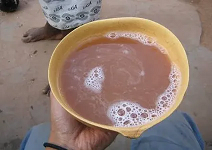 Burukutu
 peanuts and sesame
 Ibyer
Ibyer kyegh sha ishwa
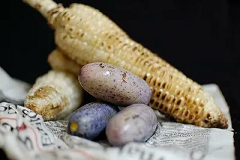 Mzembe or pears
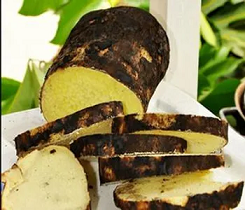 Roasted yam


Demographics
The Tiv people are an ethnic group predominantly engaged in agriculture, characterized by large farming settlements that can range in population from approximately one thousand to tens of thousands. These settlements are primarily located in Nigeria, particularly in areas where arable land is available. Notable regions where Tiv settlements can be found include Ekiti State, Kwara State, Kogi State, Niger State, Ondo State, Ogun State, and Oyo State. Despite their extensive agricultural activities, the Tiv do not assert ownership over the lands they cultivate. Instead, they typically establish agreements with the local host communities. These arrangements often include the renting of farmland and the payment of local taxes to governing authorities, such as traditional chiefs and elected officials within the local government system.[53]
The ancestral lands that the Tiv people identify as their true home include areas in the Southwest Region of Cameroon, sparsely populated settlements in the Northwest Region of Cameroon, as well as certain Nigerian states. Specifically, these areas encompass Taraba state, Nasarawa State, parts of southern Adamawa State, parts of the southeastern portion of Plateau State,[54] Northern parts of Cross River and Benue state.[53]
Cameroon
The Tiv people represent a distinct ethnic group primarily found in the Akwaya sub-division of Cameroon, situated on the south-western border of the Manyu division, with Mamfe serving as the capital, approximately 74 km from the south-eastern Nigerian border. According to the census conducted in 2005,[55] the population of the Tivoid in this region was recorded at 87,252.[56]
In addition to their primary population in Akwaya, there exist sparse and isolated communities in the Northwestern region of Cameroon, particularly in the Menchum, Mezam and Momo departments. The Cameronian Tiv are predominantly educated individuals residing in the Anglophone regions, which are considered their ancestral lands, although some have settled in francophone areas. Economically, they are primarily engaged in agriculture, although a number also hold positions within the government sector.
Prominent settlements of the Tiv include towns and villages such as Njawbaw (Njobo), Assumbo, Ballin, Batanga, Bagundu, Bakinjaw, and Assaka.[48] Moreover, the Ikyurav-tiev of Katsina-Ala are noted as some of the last Nigerian Tiv to migrate from Cameroon, where they are referred to as the Ekol.[8] This migration reflects the intricate ties and historical movements between the Tiv populations across the Nigerian-Cameroonian border.
The Tiv language, primarily spoken by the Tiv people in Cameroon, exhibits regional variations, including dialects that enhance its linguistic diversity. Notably, the Utanga(e) people, who are part of the broader Tiv community, use both Tiv and the Utanga dialect in their communication, artistic expression, and literacy. The Utanga dialect, distinct from Tiv, lacks a formal writing system and demonstrates a lexical similarity of approximately 70% with Tiv proper. This linguistic variation is attributed to the historical proximity and prolonged cohabitation of the Utanga(e) people with other ethnic groups in Cameroon.
In Nigeria, however, the majority of Tiv clans refrain from using these regional dialects, with the exception of a few communities in Cross River State, which are closer to the Cameroonian border. For instance, the Iyon people residing in Kwande do not employ an additional dialect alongside the Tiv language, whereas their counterparts in Cameroon do speak such dialects. Furthermore, the Utange clan in Ushongo, recognized as the largest of the Utanga clans, remains largely unaware of the existence of this dialect variation. This highlights the influence of geography and inter-tribal interactions on linguistic practices among the Tiv-speaking communities.[52]
The Cameroonian Tiv peoples comprise various groups including the, Utanga(e), Bitare, Mesaka, Iyive, Ceve or Becheve, Evant, Eman, Ipulo, Caka, Ikyurav, Turan, Ihyarev, Kunav, Tongov, Shitile, Undir, Oliti etc. These communities, alongside the Tiv of Nigeria, share a rich tapestry of cultural, linguistic, historical, religious, and traditional elements. The major homogenus population here occupy a total of 99 villages in the Akwaya sub-division covering an area of 3,682 square kilometers.[11]
Notable people
Justice Paul Abine Ayah ---- Presidential aspirant and Justice of the Supreme Court of Cameroon.
Aka Martin Tyoga ---- member of parliament for Akwaya constituency
Nasarawa state
The locations with the highest concentration of Tiv people in Nasarawa state are Doma, Nasarawa, Lafia, Obi, Keana, and Awe Local Government areas.[57]
Here they live in the southern part of the state which is also the south senatorial district. The Tiv clans here are the Isherev, Utyondu, Nongov and kunav.[58] They have lived here since the 16th century which predates the colonial era. They live with other tribes like the Koro, Gwandara, Kamberi, and Alago.[59]
In the early 60s and colonial times, The Lafia division was different from the munshi (Tiv) division.[23] The population of the Tiv in the Lafia division in 1963 was recorded to be 289, 559 people. The total population of the Lafia division in 1963 was 424, 219 people. This gave the Tiv 49.2 percent of the total population. The 1991 census however did not show demographics by tribes but this alone makes Tiv the dominant ethnic group in the Nasarawa south senatorial district.[60][61]
Notable people
Prof Emmanuel Kucha--- former VC University of Agriculture, Makurdi
Hon Athanasius Tyo --- 1979 – 1983 House of representatives Awe, Keana, Doma federal constituency.
Emmanuel Orshio – 1983 House of representatives Awe, Keana, Doma federal constituency.
Solomon Ihuman --- Commissioner for culture and tourism.
Philip Audu -------- Permanent Secretary water resources.
Taraba state
The Ukum, Ugondo, Shitile, Kunav, Gaav and Shangev clans are the predominant Tiv clans in Taraba state. They were some of the first migrants together with the Chamba tribes between 1750 and 1800.[62] Their largest populations are in Bali, Donga, Ibi, Gassol, Takum, Gashaka, Kurmi and Wukari Local Government Areas.[63]
There are also other Tivoid groups like the Batu, Abon, Bitare and Ambo in Sardauna Local government area.
Some of the popular towns and villages with homogenous Tiv populations are; Chanchangi, Tor Damsa, Tse Afogba, Tse Kpandi, Tor luam, Deke, China etc.[64]
Notable people
Hon. Charles Tangu Gaza – 1959 Federal House of Representatives.
Hon. Simon I. Awuah- Gongola State House of Assembly in 1979–1983.
Hon. David K. Mtwem – Gongola State House of Assembly in 1979–1983.
Hon. Simon I. Musa – First Chairman of Wukari Local Government in 1979–1983.
Hon. Hitler Gbaondo – Takum Federal Constituency in the House Representative in 1979–1983.
Hon. Tsetim Gwakyaa – Donga Federal Constituency in the House of Representatives in 1983.
Mr. Daniel Orkuma Nav- Former Permanent Secretary, Government House administration.
Mrs. Rebecca Torpeva – Former Adviser to the Governor on political affairs.
Dr. Tor-Agbidye – Former adviser to the Governor.
Mr. Emmanuel Orabunde- Former INEC Commissioner.
Anna Darius Ishaku – Former first lady of Taraba state.
Shaakaa Chira – Auditor-General of the Federation
Plateau state
There are over 50 tribes in Plateau State. The first seven in order of numerical strength are; Berom, Mwaghavul, Tarok, Angas, Jawara, Bassa and Tiv.[11]
Tiv-speaking populations are found in Langtang South, Shendam, Qua'an-Pan and Wase Local government areas. The settlements stretch from Ibi in Taraba state and Awe/Lafia in Nasarawa state into Plateau state. The populations here were carved into this state as a result of states creation by the Nigerian government.[65]
Cross River state
They occupy the northern parts of; Yala, Bekwarra, Obudu and Obanliku Local Government areas. These groups are some of the clans in Kwande local government area, Vandeikya Local government area, Konshisha local government area and Southwest Cameroon. These are the Tiv populations that were left in Crossriver state during the creation of Benue state in February 1976[66][67][68].
The sub groups here are the Kunav, Gaav, Ikyurav, Utanga(e), Ceve or Becheve, Evant, Eman etc.[69][70][71]
Benue state
They occupy Buruku, Gboko, Guma, Gwer East, Gwer West, Katsina Ala, Konshisha, Kwande, Logo, Makurdi, Tarkaa, Ushongo, Ukum and Vandeikya Local Government Areas.
Notable people
Civil servants, politicians and activists


- Joseph Tarka, politician, human rights activist
- Paul Unongo, politician, human rights activist
- Barnabas Gemade, former PDP party chairman
- Aper Aku, first civilian governor of Benue state
- George Akume, former senate minority leader
- Iyorchia Ayu, former senate president
- Prof. Ignatius Akaayar Ayua, SAN, OFR, FNIALS, former Permanent Secretary Ministry of Justice, author
- Chaha Biam, former speaker house of representative
- Gabriel Suswam, politician former governor of Benue state
- Terhemba Shija, politician, academic, poet.
- Samuel Ortom, former State Governor
- Hyacinth Alia, the current State Governor
- Daniel Saror, former minority leader
- Michael Aondoakaa, former attorney general of Nigeria
- Moses Adasu, politician, former Benue state governor
- A. I. Katsina-Alu, former chief justice of Nigeria
- Ambrose Feese, former minister of works and housing.
- Iyorwuese Hagher, former senate deputy chief whip, minister and envoy
- Yima Sen, intellectual and radical political activist
- Jerome Tilley Gyado,[72] Business man, entrepreneur.
- Emmanuel Udende, Senator from Benue state
- Titus Zam, Senator from Benue state
- Herman Hembe, former house of reps member
- Dickson Tarkighir, house of reps member
- Asema Achado , house of reps member.
Military and law enforcement
- Gideon Orkar, Nigerian Military officer.
- Victor Malu, former Chief of Army Staff
- Joseph Akahan, first Nigerian Chief of Army Staff
- Lawrence Igyuse Doki, WW 2 veteran and emancipator of Makurdi
- Joseph Akaagerger, Former Governor of Katsina state
- John Mark Inienger, former ECOMOG commander
- Commissioner Emmanuel Allagh, Former and prominent commissioner of Nigerian Police
- Farida Waziri, former EFCC Chairperson
- John Kpera, Military governor of Anambra state.
- General Gabriel Kpamber, former ECOMOG commander[73]
- Prof. Col. James T. Gire, Virginia Military Institute, USA[74]
Athletes
- Terna Suswam, football player
- Dominic Iorfa Sr, football player
- Dominic Iorfa Jr football player
- Timothy Anjembe, football player
- David Tyavkase, football player
- Jeff Varem, NBA D-league player
- Terna Nande, American football player
- Apollo Crews, WWE wrestler
- Francisca Ordega, Nigerian national team soccer player
- Mimisen Iyorhe, FIFA referee[75]
- Fanendo Adi
- Gift Orban, Nigerian footballer.
- Barnabas Imenger Jr., Nigerian super eagles striker
- Russel Orhii, World Champion Powerlifter
- Moses Kpakor Former BBL Hawks FC, BCC Lions F.C., Electricity FC, Abiola Babes F.C. and Nigerian National team player.
- Amir Angwe Former BCC Lions F.C., Julius Berger FC and Nigerian National team player.
- Tom Iorpenda, football player
Culture
- Makir Zakpe, Tor Tiv I
- Gondo Aluor, Tor-Tiv II
- Akperan Orshi, Tor-Tiv III
- Alfred Akawe Torkula, Tor Tiv IV
- James Ortese Iorzua Ayatse, Tor-Tiv V
- Akiga Sai, autobiographer and historian
Academics
- James Ayatse --- Tor Tiv V and past VC Federal University, Dutsin-Ma and UAM
- Aondoaver Tarhule ---- President Illinois State University, USA[76]
- Emmanuel Iornumbe Kucha --- past VC University of Agriculture, Makurdi
- Vershima Daniel Uza—past VC University of Agriculture, Makurdi
- Charity Angya --- Past VC Benue State University
- Richard Kimbir --- past VC University of Agriculture, Makurdi
- Erastus Orseer Gyang-Gyang --- past VC University of Agriculture, Makurdi
- Msugh Moses Kembe --- past VC Benue State University
- Akase P. Sorkaa --- past VC Benue State University
- David Ker --- past VC Benue State University
- Charles Gbilekaa Vajime --- Past VC Benue State University
- Tor Joe Iorapuu --- present VC Benue State University
Issues

Nigeria has battled insecurity for over 2 decades now. The primary perpetrators have been some Islamist fundamentalist groups like the Fulani herdsmen, Boko Haram and Islamic State – West Africa Province.
The biggest victims of these attacks have been the Tiv people from mostly Taraba state, Nasarawa state and Benue State. The fulani herdsmen have been notorious for sacking whole villages and communities and occupying them especially in places like Taraba and Nasarawa states. The best examples of these attacks that have gained international media attention are The Yelwata massacre, The 2021 Nasarawa massacre, The April 2022 Benue State killings among others.[77]
The Tiv protests together with the media outings from the elite have demonstrated that most Tiv people have lost confidence in the Nigerian government, the judiciary and its military.[78] The unrelenting attacks have brought distrust where they accuse the Federal government of censorship, no security response, no plans to return them to their homelands, no provisions for Internally Displaced Peoples camps, no arrests or prosecutions made(even when the Fulani organizations like, Miyetti Allah repeatedly claim responsibility of such attacks on live television).[79][80][81]
There has also been accusations of complicity from the Tiv through various Nigerian news channels such as Channels TV[82] and legal battles have been pursued against the governors of Nasarawa and Taraba states.[83] Such actions and sentiments arise because the Tiv complain of the selective nature of the repeated attacks on them among other minority Christian ethnic groups like the Jukun, Alago and the Chamba, the lack of provisions for Internally Displaced Peoples camps especially when other Christian minority groups (which they assume to be collateral damage) are provided these camps but the Tiv are denied access to any even when they seek refuge in such camps,[84][85] negative media outings against the Tiv by these governors etc. Some of the aggrieved victims believe the reason for these state governments complicity to be a political calculation to use the insecurity in the country as a tool to depopulate and displace them in hopes for proper political dominance from their ethnic groups when the fulani herdsmen crisis will be resolved. In Taraba state alone, 283 Tiv villages in Wukari local government area, 69 villages in Donga local government area and 37 villages in Ibi Local government area have been sacked leaving 300,000 people displaced[86]. The governor of Taraba state Agbu Kefas[87] and of Nasarawa state Abdullahi Sule[88] have also been taken to courts separately by the Tiv people for land grabbing and use of the police and military for unlawful detentions and intimidation.[89][90][91]
The Tiv victims also accuse the Nigerian military and the police stationed at these places of collusions[92][93]because of previous warnings and alarms made to them by various groups and foreign activists like the ex-Texas mayor Mike Arnold and many others before attacks and how they don't respond at all or show any concern about them and also deny previous knowledge or warnings.[94] This has prompted other activists and religious leaders like Frank Utoo and the Roman catholic Bishop of Makurdi diocese Wilfred Chikpa Anagbe to seek international help from the Vatican and other Christian groups in Europe and the USA which metamorphosed into the 2025 United States strikes in Nigeria, sactions have been also implemented on some leaders of the Fulani herdsmen, Miyetti Allah Cattle Breeders Association of Nigeria and also, designated as terrorist groups.[95][96]
See also
