
Toei 10-000 series
Japanese train type
From Wikipedia, the free encyclopedia
The Toei 10-000 series (é½å¶10-000å½¢, Toei 10-000-gata) was an electric multiple unit (EMU) train type operated by the Tokyo subway operator Tokyo Metropolitan Bureau of Transportation (Toei) on the Toei Shinjuku Line in Tokyo, Japan, from 1978 until 2018.

| Toei 10-000 series | |
|---|---|
7th-batch set 10-250 in June 2009 | |
| In service | December 1978 â February 2018 |
| Manufacturers | Alna Koki, Hitachi, Kawasaki Heavy Industries, Kinki Sharyo, Nippon Sharyo, Tokyu Car |
| Constructed | 1971â1997 |
| Entered service | 21 December 1978 |
| Refurbished | 2009â |
| Number built | 224 vehicles (28 sets) |
| Number in service | None |
| Formation | 8 cars per set |
| Operator | Toei Subway |
| Depot | Ojima |
| Lines served | Toei Shinjuku Line, Keio Line, Keio Sagamihara Line |
| Specifications | |
| Car body construction | Stainless steel |
| Car length | 20,000 mm (65 ft 7+3â8 in) |
| Width | 2,800 mm (9 ft 2+1â4 in) |
| Doors | 4 pairs per side |
| Maximum speed | 120 km/h (75 mph) |
| Traction system | Chopper control |
| Acceleration | 3.3 km/(hâ s) (2.1 mph/s) |
| Deceleration | 4.0 km/(hâ
s) (2.5 mph/s) (service) 4.5 km/(hâ s) (2.8 mph/s) (emergency) |
| Electric system | 1,500 V DC overhead wire |
| Current collection | Pantograph |
| Safety system | ATC |
| Track gauge | 1,372 mm (4 ft 6 in) |
Operations
The 10-000 series operated on the Toei Shinjuku Line between Shinjuku and Motoyawata, and also on inter-running services over the Keio Line from Shinjuku as far as Hashimoto on the Keio Sagamihara Line.[1]
Formations
By April 2017, the fleet consisted of five eight-car sets (sets 10-240 to 10-280) with six motored (M) cars and two trailer (T) cars, formed as shown below, with car 1 at the Shinjuku end.[1]
| Car No. | 1 | 2 | 3 | 4 | 5 | 6 | 7 | 8 |
|---|---|---|---|---|---|---|---|---|
| Designation | Tc2 | M2' | M1 | M2 | M1 | M2 | M1 | Tc1 |
| Numbering | 10-xx9 | 10-xx8 | 10-xx7 | 10-xx6 | 10-xx5 | 10-xx2 | 10-xx1 | 10-xx0 |
- "xx" corresponds to the set number.
- Cars 3 and 7 were each fitted with two lozenge-type pantographs, and car 5 was fitted with one.[1]
Interior
Passenger accommodation consisted of longitudinal bench seating throughout. Wheelchair spaces were added when the original six-car sets were lengthened to eight-car sets.[2]
 Interior view of a prototype set in November 2004
 Seating in October 2007
 Priority seat in October 2007


History
The prototype set, 10-010, was built in 1971, and initially tested on the Toei Mita Line.[3][4]
Refurbishment commenced in fiscal 2009. This consisted of adding external speakers, replacing the original roller blind destination indicators with LED indicators, moving the body side destination indicators from the ends to a central position, and adding interior passenger information displays.[2]

In 2005 and 2006, the 10-xx7 and 10-xx8 cars of sets 10-010 to 10-180 were refurbished and reformed with new driving cars to become 10-300R series. These cars were built between 1986 and 1989 as batches 3 and 5 to lengthen original 6-car sets to 8 cars, and so were still relatively new compared to the rest of the cars in the sets in which they were contained.[5]
The final set, 10-280, was retired on 11 February 2018.[6]
Build details
| Set No. | Batch | Delivery date | Manufacturer | Remarks |
|---|---|---|---|---|
| 10-010 | - | 26 November 1971 | Nippon Sharyo | Prototype, built as 4-car set. Lengthened to 6 cars in November 1978, and to 8 cars in October 1988. |
| 10-020 | 1 | 10 November 1978 | Tokyu Car | Initially built as 6-car sets. Lengthened to 8 cars with addition of 5th-batch cars between 1988 and 1989. |
| 10-030 | ||||
| 10-040 | ||||
| 10-050 | ||||
| 10-060 | ||||
| 10-070 | ||||
| 10-080 | ||||
| 10-090 | ||||
| 10-100 | 2 | 20 October 1979 | Nippon Sharyo | Initially built as 6-car sets. Lengthened to 8 cars with addition of 5th-batch cars in 1989 |
| 10-110 | ||||
| 10-120 | Initially built as 6-car sets. Lengthened to 8 cars with addition of 3rd-batch cars in July 1986. | |||
| 10-130 | 17 December 1979 | |||
| 10-140 | ||||
| 10-150 | ||||
| 10-160 | ||||
| 10-170 | ||||
| 10-180 | ||||
| 10-190 | 3 | 23 April 1986 | Hitachi | Air-conditioning fitted 1993â1995. |
| 10-200 | 20 May 1986 | |||
| 10-210 | 25 July 1986 | |||
| 10-220 | 4 | 10 May 1988 | Kinki Sharyo | |
| 10-230 | 24 May 1988 | |||
| 10-240 | 6 | 27 February 1989 | ||
| 10-250 | 7 | 25 March 1992 | ||
| 10-260 | ||||
| 10-270 | 8 | 12 December 1997 | Alna Koki | Lightweight stainless steel construction. |
| 10-280 |
The original six-car sets were later lengthened to eight cars with the addition of pairs of 3rd-batch (14 vehicles built in 1986 by Hitachi) and 5th-batch (22 vehicles built between 1988 and 1989 by Kawasaki Heavy Industries) cars.[5]
 Prototype set 10-010 in November 2004
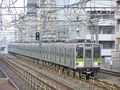 1st-batch set 10-030 in July 2006
 3rd-batch set 10-190 in October 2009
 Refurbished 4th-batch set 10-230 in August 2012
 6th-batch set 10-240 in May 2017
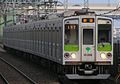 7th-batch set 10-260 in October 2006
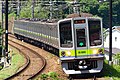 8th-batch set 10-280 in May 2017


