Tokyo Monorail 10000 series
From Wikipedia, the free encyclopedia
| Tokyo Monorail 10000 series | |
|---|---|
 Set 10081 in May 2021 | |
 | |
| In service | July 18, 2014 – Present |
| Manufacturer | Hitachi Rail[1] |
| Built at | Yamaguchi |
| Family name | Hitachi Monorail |
| Replaced | 1000 series |
| Constructed | 2014– |
| Number built | 48 vehicles (8 sets) |
| Number in service | 48 vehicles (8 sets) |
| Formation | 6 cars per trainset |
| Fleet numbers | 10011–10081 |
| Operators | Tokyo Monorail |
| Depots | Showajima |
| Lines served | Tokyo Monorail Haneda Airport Line |
| Specifications | |
| Car body construction | Aluminium alloy |
| Car length |
|
| Width | 3,038 mm (9 ft 11.6 in) |
| Height | 4,364 mm (14 ft 3.8 in) |
| Doors | 2 pairs per side |
| Maximum speed | 80 km/h (50 mph) |
| Traction system | Hitachi VFI-HR4810B[2] 2-level IGBT–VVVF |
| Traction motors | 16 × Hitachi HS37627-03RB[2] 100 kW (134 hp) asynchronous 3-phase AC |
| Power output | 1.6 MW (2,146 hp) |
| Acceleration | 3.5 km/(h⋅s) (2.2 mph/s) |
| Deceleration |
|
| Electric system(s) | 750 V DC |
| Current collection | Side contact |
| UIC classification | 2′2′+Bo′Bo′+Bo′Bo′+Bo′Bo′+Bo′Bo′+2′2′ |
| Safety system(s) | ATC |
| Track gauge | (straddle-beam monorail) |
The Tokyo Monorail 10000 series (東京モノレール10000形, Tōkyō Monorēru 10000-gata) is a monorail electric multiple unit (EMU) train type operated by the Tokyo Monorail on the Tokyo Monorail Haneda Airport Line in Japan since July 2014.[3]
The body design is based on the earlier 2000 series trains first built in 1997, and uses friction stir welded (FSW) aluminum alloy panels.[4]
 The interior of the driving cab

Formation
As of 1 April 2021[update], the fleet consists of eight six-car sets, numbered 10011 to 10081, and formed as shown below, with four motored ("M") cars and two non-powered trailer ("T") cars.[3] Car 1 is at the Hamamatsucho end.[3][5]
| Car No. | 1 | 2 | 3 | 4 | 5 | 6 |
|---|---|---|---|---|---|---|
| Designation | Tc1 | M1 | M2 | M3 | M4 | Tc2 |
| Numbering | 100x1 | 100x2 | 100x3 | 100x4 | 100x5 | 100x6 |
| Weight (t) | 23.3 | 23.7 | 24.1 | 23.8 | 24.0 | 23.0 |
| Capacity (seated/total) | 33/76 | 40/76 | 33/76 | |||
- "x" stands for the set number.
- Cars 1 and 6 each have a wheelchair space.[5]
Interior
Passenger accommodation consists of a mixture of facing 4-seat bays and longitudinal bench seating, and includes baggage racks next to the doorways.[4] The seats are covered in a blue moquette incorporating the traditional Japanese seigaiha (青海波) pattern.[4] LED lighting is used throughout.[4] Passenger information is provided by 7-inch (178 mm) wide LCD displays above the doorways.[4] Information is provided in four languages: Japanese, English, Chinese, and Korean. Initially one screen is provided above each doorway, but provision is made for installing a second screen in the future.[4]
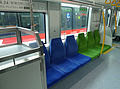 Longitudinal seating
 Facing 4-seat bays
 Seating over the train bogies


