Tokyu 9000 series
Japanese electric multiple unit train type
From Wikipedia, the free encyclopedia
The Tokyu 9000 series (Japanese: 東急9000系, Hepburn: Tōkyū 9000-kei) is a Japanese commuter electric multiple unit (EMU) train type operated by the private railway operator Tokyu Corporation in the Tokyo area of Japan. Introduced into service in March 1986, 14 eight-car sets and a five-car set were built between 1986 and 1991 by Tokyu Car Corporation for use on the Tokyu Toyoko and Oimachi lines. Between 2009 and 2013, the 9000 series sets allocated to Toyoko Line operations were transferred to the Oimachi Line.

| Tokyu 9000 series | |
|---|---|
Set 9009 on the Oimachi Line in December 2021 | |
| In service | 1986 – present |
| Manufacturer | Tokyu Car Corporation |
| Constructed | 1986–1991 |
| Entered service | 9 March 1986 |
| Refurbished | 2004 – present |
| Number built | 117 vehicles (15 sets) |
| Number in service | 75 vehicles (15 sets) |
| Formation | 5 (formerly 8) cars per trainset |
| Fleet numbers | 9001–9015 |
| Operators |
|
| Depots | |
| Lines served |
|
| Specifications | |
| Car body construction | Stainless steel |
| Car length | 20 m (65 ft 7 in) |
| Width | 2.8 m (9 ft 2 in) |
| Doors | 4 pairs per side |
| Traction system | Variable frequency (GTO) |
| Power output | 170 kW per motor[3] |
| Electric system | 1,500 V DC overhead |
| Current collection | Pantograph |
| Track gauge | 1,067 mm (3 ft 6 in) |


Design
Cars are 20 metres (66 ft) long, 2.8 m (9 ft 2 in) wide, and have four pairs of doors per side. While they retain the stainless steel bodies used by older Tokyu train types, they have an offset front-end door. In addition, the 9000 series was the first train type to use variable-frequency drive (more commonly referred to as VVVF) technology from new.[4][5] Since its introduction in 1986, all subsequent Tokyu train types would implement the technology.[6]
The design of the 9000 series was the basis for the later Tokyu 1000 series[7] and 2000 series train types.[8]
Formations
Toyoko Line
The Toyoko Line fleet consisted of 14 eight-car sets, formed as follows.[1]
| ← ShibuyaMotomachi-Chukagai → | ||||||||
| Designation | KuHa 9000 (Tc2) |
DeHa 9200 (M) |
SaHa 9700 (T2) |
DeHa 9300 (M) |
SaHa 9800 (T1) |
DeHa 9400 (M) |
DeHa 9600 (M0) |
KuHa 9100 (Tc1) |
| Numbering | 9001 : 9006 |
9201 : 9206 |
9701 : 9706 |
9301 : 9306 |
9801 : 9806 |
9401 : 9406 |
9601 : 9606 |
9101 : 9106 |
| 9008 : 9015 |
9208 : 9215 |
9708 : 9715 |
9308 : 9315 |
9808 : 9815 |
9408 : 9415 |
9608 : 9615 |
9108 : 9115 | |
- The motored cars were each fitted with one lozenge-type pantograph.[1]
Oimachi Line
Oimachi Line sets are formed as follows.[2]
| ← MizonokuchiOimachi → | |||||
| Car No. | 5 | 4 | 3 | 2 | 1 |
| Designation | KuHa 9000 (Tc2) |
DeHa 9200 (M) |
DeHa 9400 (M) |
DeHa 9600 (M) |
KuHa 9100 (Tc1) |
| Wheel arrangement (AAR) | 2-2 | B-B | B-B | B-B | 2-2 |
| Numbering | 9001 : 9015 |
9201 : 9215 |
9401 : 9415 |
9601 : 9615 |
9101 : 9115 |
- Cars 2, 3, and 4 are each fitted with one single-arm pantograph.
Interior
Passenger accommodation consists primarily of longitudinal seating. Priority seating is composed of transverse seating bays.[9]
 Interior view
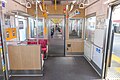 Priority seating


History
The 9000 series fleet consists of 117 vehicles which were built by Tokyu Car Corporation. Construction commenced in 1986 and continued until 1991. The vehicles were initially formed into 14 eight-car sets and a five-car set, numbered 9001 to 9015. The train type first entered service on the Tokyu Toyoko Line in March 1986, and the sole five-car set (9007) was introduced on the Tokyu Oimachi Line in 1988.[1][2]
Refurbishment
From fiscal 2004,[10] the 9000 series fleet underwent a programme of interior refurbishment. The programme included the removal of intermediate partitions in favor of stanchion poles for seven-person seats, installation of onboard passenger information displays, and replacement of the original mixture of brown and orange seat moquette. The seat backs received patterned moquette, whereas the seats received plain red moquette.[9]
 The interior of a 9000 series set in as-built condition
 The interior of a refurbished 9000 series set


Transfer to the Tokyu Oimachi Line

Set 9007 was the only 9000 series trainset on the Oimachi Line until July 2009, when eight-car set 9002 was transferred from Motosumiyoshi depot to Nagatsuta depot for use on the line. It was shortened to a five-car formation, and its solid-red front-end bands were replaced with ones with a red-to-orange gradient.[11] The rest of the fleet was transferred and modified as such from then, with the last of these sets—9001, 9005, and 9010—being withdrawn from Toyoko Line operations between 14 and 15 March 2013.[12] They were transferred to Nagatsuta shortly thereafter.[13]
 8-car set 9001 with a headmark commemorating its final run on the Toyoko Line, February 2013

Future replacement and transfer to Seibu Railway
In May 2024, Tokyu Railway announced that as part of its Fiscal Year 2024 capital investment plan, the 9000 series, together with the Tokyu 9020 series, is scheduled to be replaced with a new fleet of rolling stock based on the Tokyu 6020 series.[14]
On 26 September 2023, it was announced that Tokyu Railway would be transferring over a number of 9000 series sets to the Seibu Railway, together with some Odakyu 8000 series sets from Odakyu Railway.[15][16] The 9000 series is expected to enter service with Seibu from Fiscal Year 2025 onwards and the transfer is expected to be completed by Fiscal Year 2029. Seibu announced that these sets will be used on branch lines such as the Tamako line, Tamagawa line, Chichibu line and the Sayama line.
According to Seibu's official YouTube channel, the transferred Tokyu 9000 series will be renamed Seibu 7000. [17]
