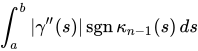
Total curvature
From Wikipedia, the free encyclopedia

In mathematical study of the differential geometry of curves, the total curvature of an immersed plane curve is the integral of curvature along a curve taken with respect to arc length:
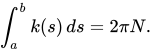
The total curvature of a closed curve is always an integer multiple of 2π, where N is called the index of the curve or turning number – it is the winding number of the unit tangent vector about the origin, or equivalently the degree of the map to the unit circle assigning to each point of the curve, the unit tangent vector at that point (a kind of Gauss map).
This relationship between a local geometric invariant, the curvature, and a global topological invariant, the index, is characteristic of results in higher-dimensional Riemannian geometry such as the Gauss–Bonnet theorem.
Invariance
According to the Whitney–Graustein theorem, the total curvature is invariant under a regular homotopy of a curve: it is the degree of the Gauss map. However, it is not invariant under homotopy: passing through a kink (cusp) changes the turning number by 1.
By contrast, winding number about a point is invariant under homotopies that do not pass through the point, and changes by 1 if one passes through the point.