Total internal reflection microscopy
From Wikipedia, the free encyclopedia

Total internal reflection microscopy is a specialized optical imaging technique for object tracking and detection utilizing the light scattered from an evanescent field in the vicinity of a dielectric interface. Its advantages are a high signal-to-noise ratio and a high spatial resolution in the vertical dimension.
Total internal reflection of light occurs at the interface between materials of differing indices of refraction at incident angles greater than the critical angle, , where


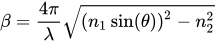
and is the index of the incident medium and the index of the transmission medium and is measured from the normal to the interface.


Under conditions of total internal reflection, the electromagnetic field in the transmission medium takes on the form of an evanescent wave, whose intensity decays exponentially with distance from the interface such that,

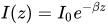
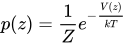
with . For practical purposes, the transmission medium is often chosen to be a fluid—usually water—in which a microscopic object can be immersed. The object, when brought close to the interface, is expected to scatter light proportional to the intensity of the field at its height, .[1] Since the penetration depth of the evanescent field is on the order of hundreds of nanometers, this technique is among the most sensitive for tracking displacements in the direction perpendicular to a surface.[2]