The mathematical link between them comes from the formula of the price elasticity of demand:

where  stands for Price,
  for quantity demanded,
  for change in quantity demanded, and
  for change in price.[1] Here the minus sign converts the result to a non-negative number, as is conventional but not universal.
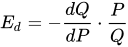
Using the idea of limits for infinitesimal changes in price and therefore in quantity, the formula becomes
Total revenue is given by  .
.
Since quantity demanded Q is a function of price P,  total revenue can be rewritten as

The derivative of total revenue with respect to P is thus:

But  , so
, so 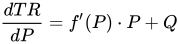 .
.
After both multiplying and dividing by , the equation can be rewritten as:
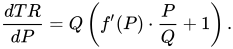
The last step is to substitute the elasticity of demand for  to obtain:
 .
.
To find the elasticity of demand using the mathematical explanation of the total revenue test, it's necessary to use the following rule:
If demand is elastic,  , then
  : price and total revenue move in opposite directions.
If demand is inelastic,
: price and total revenue move in opposite directions.
If demand is inelastic,  , then
  : price and total revenue change in the same direction.
If demand is unit elastic,
: price and total revenue change in the same direction.
If demand is unit elastic,  , then
  : an increase in price has no influence on the total revenue.


