Tradescantia zanonia
Species of plant
From Wikipedia, the free encyclopedia
Tradescantia zanonia, formerly known as Campelia zanonia, is an evergreen perennial subshrub of the dayflower family, closely related to Tradescantia zebrina.[2][3] It is native to the tropical Americas, ranging from Mexico through Central America and the Caribbean to Bolivia and southern Brazil.[1] Its common names include cañagria, cascajo flor, cinta, rascadera, and suelda.[1]

| Tradescantia zanonia | |
|---|---|
| |
Scientific classification  | |
| Kingdom: | Plantae |
| Clade: | Embryophytes |
| Clade: | Tracheophytes |
| Clade: | Spermatophytes |
| Clade: | Angiosperms |
| Clade: | Monocots |
| Clade: | Commelinids |
| Order: | Commelinales |
| Family: | Commelinaceae |
| Genus: | Tradescantia |
| Species: | T. zanonia |
| Binomial name | |
| Tradescantia zanonia | |
| Synonyms[1] | |
|
Synonymy
| |
Its capsule is covered by the fleshy purple-black calyx, hence a berry-like appearance.[4]
It is cultivated as a greenhouse ornamental. There is a variegated cultivar named 'Mexican Flag'.
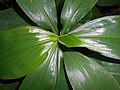 Green leaves
 'Mexican Flag'
 A blooming plant of 'Mexican Flag'
 Flower
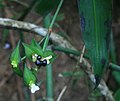 Berry-like capsules


