Since mathematical structures are often defined in reference to an underlying space, many examples of transport of structure involve spaces and mappings between them. For example, if  and
and  are vector spaces with
  being an inner product on , such that there is an isomorphism
  from to , then one can define an inner product
 ![{\displaystyle [\cdot ,\cdot ]}](https://wikimedia.org/api/rest_v1/media/math/render/svg/28dd4c22d60192519c1c12cf645b040f368db9e9) on by the following rule:
on by the following rule:
![{\displaystyle [v_{1},v_{2}]=(\phi (v_{1}),\phi (v_{2}))}](https://wikimedia.org/api/rest_v1/media/math/render/svg/74f140f0f7499beff1751d4a094f1890d9150a95)
Although the equation makes sense even when is not an isomorphism, it only defines an inner product on when is, since otherwise it will cause to be degenerate. The idea is that allows one to consider and as "the same" vector space, and by following this analogy, then one can transport an inner product from one space to the other.
A more elaborated example comes from differential topology, in which the notion of smooth manifold is involved: if  is such a manifold, and if
  is any topological space which is homeomorphic to , then one can consider as a smooth manifold as well. That is, given a homeomorphism
  , one can define coordinate charts on by "pulling back" coordinate charts on through . Recall that a coordinate chart on is an open set
  together with an injective map

for some natural number  ; to get such a chart on , one uses the following rules:
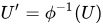 and
and  .
.
Furthermore, it is required that the charts cover (the fact that the transported charts cover follows immediately from the fact that is a bijection). Since is a smooth manifold, if U and V, with their maps and  , are two charts on , then the composition, the "transition map"
 (a self-map of
  )
)
is smooth. To verify this for the transported charts on , notice that
 ,
,
and therefore
 , and
, and .
.
Thus the transition map for  and
and  is the same as that for and , hence smooth. That is, is a smooth manifold via transport of structure. This is a special case of transport of structures in general.[2]
The second example also illustrates why "transport of structure" is not always desirable. Namely, one can take to be the plane, and to be an infinite one-sided cone. By "flattening" the cone, a homeomorphism of and can be obtained, and therefore the structure of a smooth manifold on , but the cone is not "naturally" a smooth manifold. That is, one can consider as a subspace of 3-space, in which context it is not smooth at the cone point.
A more surprising example is that of exotic spheres, discovered by John Milnor, which states that there are exactly 28 smooth manifolds which are homeomorphic but not diffeomorphic to  , the 7-dimensional sphere in 8-space. Thus, transport of structure is most productive when there exists a canonical isomorphism between the two objects.