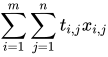
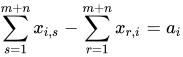
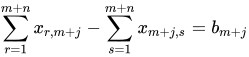
Since in most cases an explicit expression for the objective function does not exist, an alternative method is suggested by Rajeev and Satya. The method uses two consecutive phases to reveal the minimal durational route from the origins to the destinations. The first phase is willing to solve  time-minimizing problem, in each case using the remained
  intermediate nodes as transshipment points. This also leads to the minimal-durational transportation between all sources and destinations. During the second phase a standard time-minimizing problem needs to be solved. The solution of the time-minimizing transshipment problem is the joint solution outcome of these two phases.
Since costs are independent from the shipped amount, in each individual problem one can normalize the shipped quantity to 1. The problem now is simplified to an assignment problem from i to m+j. Let  be 1 if the edge between nodes r and s is used during the optimization, and 0 otherwise. Now the goal is to determine all
  which minimize the objective function:
 ,
,
such that


 .
.
 and need to be excluded from the model; on the other hand, without the constraint the optimal path would consist only of
  -type loops which obviously can not be a feasible solution.
- Instead of ,
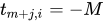 can be written, where M is an arbitrarily large positive number. With that modification the formulation above is reduced to the form of a standard assignment problem, possible to solve with the Hungarian method.
During the second phase, a time minimization problem is solved with m origins and n destinations without transshipment. This phase differs in two main aspects from the original setup:
- Transportation is only possible from an origin to a destination
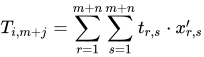
- Transportation time from i to m+j is the sum of durations coming from the optimal route calculated in Phase 1. Worthy to be denoted by
 in order to separate it from the times introduced during the first stage.
The goal is to find  which minimize
 ,
,
such that
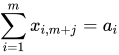
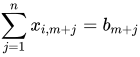
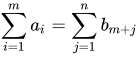
This problem is easy to be solved with the method developed by Prakash. The set  needs to be partitioned into subgroups
  , where each
  contain the -s with the same value. The sequence is organized as
  contains the largest valued 's
  the second largest and so on. Furthermore,
  positive priority factors are assigned to the subgroups
  , with the following rule:

for all  . With this notation the goal is to find all
  which minimize the goal function
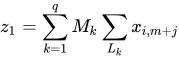
such that