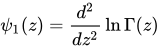
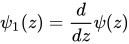
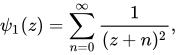
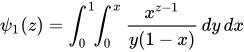
Summarize Timeline Top Qs Fact Check A double integral representation, as an alternative to the ones given above, may be derived from the series representation:
ψ
1
(
z
)
=
∫
0
1
∫
0
x
x
z
−
1
y
(
1
−
x
)
d
y
d
x
{\displaystyle \psi _{1}(z)=\int _{0}^{1}\!\!\int _{0}^{x}{\frac {x^{z-1}}{y(1-x)}}\,dy\,dx}
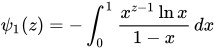
using the formula for the sum of a geometric series . Integration over y
ψ
1
(
z
)
=
−
∫
0
1
x
z
−
1
ln
x
1
−
x
d
x
{\displaystyle \psi _{1}(z)=-\int _{0}^{1}{\frac {x^{z-1}\ln {x}}{1-x}}\,dx}
An asymptotic expansion as a Laurent series can be obtained via the derivative of the asymptotic expansion of the digamma function :
ψ
1
(
z
)
∼
d
d
z
(
ln
z
−
∑
n
=
1
∞
B
n
n
z
n
)
=
1
z
+
∑
n
=
1
∞
B
n
z
n
+
1
=
∑
n
=
0
∞
B
n
z
n
+
1
=
1
z
+
1
2
z
2
+
1
6
z
3
−
1
30
z
5
+
1
42
z
7
−
1
30
z
9
+
5
66
z
11
−
691
2730
z
13
+
7
6
z
15
⋯
{\displaystyle {\begin{aligned}\psi _{1}(z)&\sim {\operatorname {d} \over \operatorname {d} \!z}\left(\ln z-\sum _{n=1}^{\infty }{\frac {B_{n}}{nz^{n}}}\right)\\&={\frac {1}{z}}+\sum _{n=1}^{\infty }{\frac {B_{n}}{z^{n+1}}}=\sum _{n=0}^{\infty }{\frac {B_{n}}{z^{n+1}}}\\&={\frac {1}{z}}+{\frac {1}{2z^{2}}}+{\frac {1}{6z^{3}}}-{\frac {1}{30z^{5}}}+{\frac {1}{42z^{7}}}-{\frac {1}{30z^{9}}}+{\frac {5}{66z^{11}}}-{\frac {691}{2730z^{13}}}+{\frac {7}{6z^{15}}}\cdots \end{aligned}}}
where B n n Bernoulli number and we choose B 1 = 1 / 2
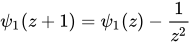
The trigamma function satisfies the recurrence relation
ψ
1
(
z
+
1
)
=
ψ
1
(
z
)
−
1
z
2
{\displaystyle \psi _{1}(z+1)=\psi _{1}(z)-{\frac {1}{z^{2}}}}
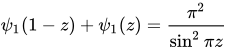
and the reflection formula
ψ
1
(
1
−
z
)
+
ψ
1
(
z
)
=
π
2
sin
2
π
z
{\displaystyle \psi _{1}(1-z)+\psi _{1}(z)={\frac {\pi ^{2}}{\sin ^{2}\pi z}}\,}
which immediately gives the value for z = 1 / 2
ψ
1
(
1
2
)
=
π
2
2
{\displaystyle \psi _{1}({\tfrac {1}{2}})={\tfrac {\pi ^{2}}{2}}}
Special values
At positive integer values we have that
ψ
1
(
n
)
=
π
2
6
−
∑
k
=
1
n
−
1
1
k
2
,
ψ
1
(
1
)
=
π
2
6
,
ψ
1
(
2
)
=
π
2
6
−
1
,
ψ
1
(
3
)
=
π
2
6
−
5
4
.
{\displaystyle \psi _{1}(n)={\frac {\pi ^{2}}{6}}-\sum _{k=1}^{n-1}{\frac {1}{k^{2}}},\qquad \psi _{1}(1)={\frac {\pi ^{2}}{6}},\qquad \psi _{1}(2)={\frac {\pi ^{2}}{6}}-1,\qquad \psi _{1}(3)={\frac {\pi ^{2}}{6}}-{\frac {5}{4}}.}
ψ
1
(
n
+
1
2
)
=
π
2
2
−
4
∑
k
=
1
n
1
(
2
k
−
1
)
2
,
ψ
1
(
1
2
)
=
π
2
2
,
ψ
1
(
3
2
)
=
π
2
2
−
4.
{\displaystyle \psi _{1}\left(n+{\frac {1}{2}}\right)={\frac {\pi ^{2}}{2}}-4\sum _{k=1}^{n}{\frac {1}{(2k-1)^{2}}},\qquad \psi _{1}\left({\tfrac {1}{2}}\right)={\frac {\pi ^{2}}{2}},\qquad \psi _{1}\left({\tfrac {3}{2}}\right)={\frac {\pi ^{2}}{2}}-4.}
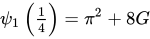
The trigamma function has other special values such as:
ψ
1
(
1
4
)
=
π
2
+
8
G
{\displaystyle \psi _{1}\left({\tfrac {1}{4}}\right)=\pi ^{2}+8G}
where G represents Catalan's constant .
There are no roots on the real axis of ψ 1 zn , zn Re z < 0 . Each such pair of roots approaches Re zn = −n + 1 / 2 quickly and their imaginary part increases slowly logarithmic with n . For example, z 1 = −0.4121345... + 0.5978119...i z 2 = −1.4455692... + 0.6992608...i Im(z ) > 0 .
Relation to the Clausen function
The digamma function at rational arguments can be expressed in terms of trigonometric functions and logarithm by the digamma theorem . A similar result holds for the trigamma function but the circular functions are replaced by Clausen's function . Namely,[ 1]
ψ
1
(
p
q
)
=
π
2
2
sin
2
(
π
p
/
q
)
+
2
q
∑
m
=
1
(
q
−
1
)
/
2
sin
(
2
π
m
p
q
)
Cl
2
(
2
π
m
q
)
.
{\displaystyle \psi _{1}\left({\frac {p}{q}}\right)={\frac {\pi ^{2}}{2\sin ^{2}(\pi p/q)}}+2q\sum _{m=1}^{(q-1)/2}\sin \left({\frac {2\pi mp}{q}}\right){\textrm {Cl}}_{2}\left({\frac {2\pi m}{q}}\right).}