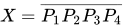
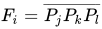
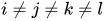
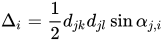
Take the tetrahedron  , and consider the point
  as an apex. The Alternating sines theorem is given by the following identity:
 One may view the two sides of this identity as corresponding to clockwise and counterclockwise orientations of the surface.

Putting any of the four vertices in the role of O yields four such identities, but at most three of them are independent; if the "clockwise" sides of three of the four identities are multiplied and the product is inferred to be equal to the product of the "counterclockwise" sides of the same three identities, and then common factors are cancelled from both sides, the result is the fourth identity.
Three angles are the angles of some triangle if and only if their sum is 180° (π radians). What condition on 12 angles is necessary and sufficient for them to be the 12 angles of some tetrahedron? Clearly the sum of the angles of any side of the tetrahedron must be 180°. Since there are four such triangles, there are four such constraints on sums of angles, and the number of degrees of freedom is thereby reduced from 12 to 8. The four relations given by the sine law further reduce the number of degrees of freedom, from 8 down to not 4 but 5, since the fourth constraint is not independent of the first three. Thus the space of all shapes of tetrahedra is 5-dimensional.[3]
See: Law of sines
The law of cosines for the tetrahedron[4] relates the areas of each face of the tetrahedron and the dihedral angles about a point. It is given by the following identity:

Take the general tetrahedron and project the faces  onto the plane with the face
  . Let
. Let  .
.
Then the area of the face is given by the sum of the projected areas, as follows: By substitution of
  with each of the four faces of the tetrahedron, one obtains the following homogeneous system of linear equations:
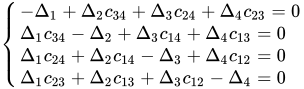 This homogeneous system will have solutions precisely when:
 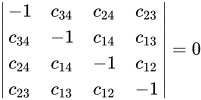 By expanding this determinant, one obtains the relationship between the dihedral angles of the tetrahedron,[1] as follows:
Take the general tetrahedron and let  be the point on the edge
  and
and  be the point on the edge
  such that the line segment
  is perpendicular to both & . Let
  be the length of the line segment .
To find :[1]
First, construct a line through  parallel to
  and another line through parallel to . Let
  be the intersection of these two lines. Join the points and
  . By construction,
  is a parallelogram and thus
  and
and  are congruent triangles. Thus, the tetrahedron and
  are equal in volume.
As a consequence, the quantity is equal to the altitude from the point to the face  of the tetrahedron
  ; this is shown by translation of the line segment .
By the volume formula, the tetrahedron satisfies the following relation:  where
where  is the area of the triangle . Since the length of the line segment
  is equal to
  (as is a parallelogram):
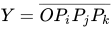
  where
where 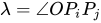 . Thus, the previous relation becomes:
  To obtain
  , consider two spherical triangles:
- Take the spherical triangle of the tetrahedron at the point ; it will have sides
 and opposite angles
  . By the spherical law of cosines:
- Take the spherical triangle of the tetrahedron at the point . The sides are given by
 and the only known opposite angle is that of
  , given by
  . By the spherical law of cosines:
Combining the two equations gives the following result:
Making  the subject:
 Thus, using the cosine law and some basic trigonometry:
 Thus:
Thus: So:
So:
 and
and  are obtained by permutation of the edge lengths.
Note that the denominator is a re-formulation of the Bretschneider-von Staudt formula, which evaluates the area of a general convex quadrilateral.