Tug of war (astronomy)
From Wikipedia, the free encyclopedia
The tug of war in astronomy is the ratio of planetary and solar attractions on a natural satellite. The term was coined by Isaac Asimov in The Magazine of Fantasy and Science Fiction in 1963.[1]
According to Isaac Newton's law of universal gravitation
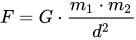
In this equation
- F is the force of attraction
- G is the gravitational constant
- m1 and m2 are the masses of two bodies
- d is the distance between the two bodies
The two main attraction forces on a satellite are the attraction of the Sun and the satellite's primary (the planet the satellite orbits). Therefore, the two forces are
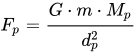
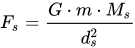
where the subscripts p and s represent the primary and the Sun respectively, and m is the mass of the satellite.
The ratio of the two is
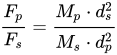
Example
Callisto is a satellite of Jupiter. The parameters in the equation are [2]
- Callisto–Jupiter distance (dp) is 1.883 · 106 km.
- Mass of Jupiter (Mp) is 1.9 · 1027 kg
- Jupiter–Sun distance (i.e. mean distance of Callisto from the Sun, ds) is 778.3 · 106 km.
- The solar mass (Ms) is 1.989 · 1030 kg

The ratio 163 shows that the solar attraction is much weaker than the planetary attraction.