Türi
Town in Estonia
From Wikipedia, the free encyclopedia
Türi is a town in Järva County, Estonia. It is the administrative centre of Türi Parish.[3] Due to its spring flower fairs, which have been held since 1977 and are known throughout Estonia, Türi has also been known as the "spring capital" of Estonia since 2000.[4]

Türi | |
|---|---|
| |
  Türi | |
| Coordinates: 58°48′34″N 25°25′45″E | |
| Country |  Estonia Estonia |
| County | Järva County |
| Municipality | Türi Parish |
| Town status | 1926 |
| Area | |
• Total | 9.79 km2 (3.78 sq mi) |
| Population (2024)[2] | |
• Total | 5,186 |
| • Rank | 24th |
| • Density | 530/km2 (1,370/sq mi) |
| Time zone | UTC+2 (EET) |
| • Summer (DST) | UTC+3 (EEST) |
It has a railway station on the Tallinn - Viljandi railway line operated by Elron (rail transit).
History
- ca 1250 The Catholic (now Lutheran) St. Martin's Church was established in Türi
- 1347 Türi first mentioned in written records (German: Turgel)
- 1687 The establishment of the first school
- 1900 Railway traffic (Viljandi–Tallinn, Türi–Paide) opened
- 1917 Türi gains the rights of a market town
- 1924 The first secondary education institution in Türi opened – Türi Horticultural Gymnasium
- 1926 The rights of a town given to Türi
- 1937 Erection of a 197 m-tall (646 ft) radio mast.
- 1941 The radio mast was blown up by Soviet Union forces
- 1950 - 1959 Türi - the centre of Türi County.
- 1995 Türi Museum opened.
- 1997 Türi College of the University of Tartu for environmental science studies opened
- 2000 Türi declared the Spring Capital of Estonia by Mart Laar, the prime minister of Estonia
- 2005 Türi became the administrative centre of newly formed Türi Parish.
Türi Church
Türi Church, originally dedicated to St. Martin, is a well-preserved medieval hall church of a form typical for central Estonia. Construction of the church probably started in the late 13th century and the ceiling was completed in the early 14th century. It retains much of its medieval look, including carved stone details such as consoles in the form of human heads. Other noteworthy interior details include the renaissance pulpit, a Baroque retable (by Christian Ackermann) and an altar painting by August Georg Wilhelm Pezold from 1856.[5]
Gallery
 St. Martin Church of Türi (southern side)
 Türi in 1910
 Türi in 1929
 Türi railway station
 Türi reservoir
 Türi cultural center
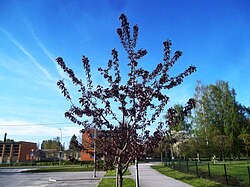 View of Türi (2014)
 Türi school
 Türi Kevade School for the disabled

_jaam.jpg)


Notable people
- Arvo Junti (born 1953), lawyer and politician.
- Kaia Iva (1964–2023), Mayor of Türi, 2002 to 2005, member of Riigikogu, 2007 to 2015 and Minister of Social Protection from 2016.
- Kristiina Poska (born 1978), conductor and principal guest conductor of the Latvian National Symphony Orchestra in 2021.
- Aleksander Saharov (born 1982), former footballer who played about 170 games and is now a beach soccer player.
- Kristian Marmor (born 1987), footballer who played over 170 games and also beach soccer player, having played 57 games for Estonia national beach soccer team.
