Ultrabright electron
From Wikipedia, the free encyclopedia
Ultrabright electrons are an advanced atomic imaging tool that can allow scientists to view atoms and molecules in motion.[1] They were developed at the Max Planck Institute for the Structure and Dynamics of Matter in Hamburg, Germany and at the University of Toronto with the teams led by Professor R.J.D. Miller.[1]
The brightness of an electron beam is defined for any given point as the current per unit area normal to the given direction, per unit solid angle. Mathematically this is defined using limits as the area and solid angle tend to 0. The general formula is,
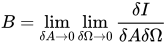
An ultrabright electron beam has been defined as having >10 A/cm2 with spatial coherence of >1 nm.[1] This level of energy with that small amount of coherence is a large technical problem, not only in the production of such a beam, but also how to use the beam without destroying the sample in the process of characterization.[1] The singular problem of sample destruction was taken care of by studying reactions that are photo-active and prepared in such a way that reduced potential barriers.[1]