Ultragraph C*-algebra
From Wikipedia, the free encyclopedia
In mathematics, an ultragraph C*-algebra is a universal C*-algebra generated by partial isometries on a collection of Hilbert spaces constructed from ultragraphs.[1]pp. 6-7. These C*-algebras were created in order to simultaneously generalize the classes of graph C*-algebras and Exel–Laca algebras, giving a unified framework for studying these objects.[1] This is because every graph can be encoded as an ultragraph, and similarly, every infinite graph giving an Exel-Laca algebras can also be encoded as an ultragraph.
Ultragraphs
An ultragraph consists of a set of vertices , a set of edges , a source map , and a range map taking values in the power set collection of nonempty subsets of the vertex set. A directed graph is the special case of an ultragraph in which the range of each edge is a singleton, and ultragraphs may be thought of as generalized directed graph in which each edges starts at a single vertex and points to a nonempty subset of vertices.





Example


An easy way to visualize an ultragraph is to consider a directed graph with a set of labelled vertices, where each label corresponds to a subset in the image of an element of the range map. For example, given an ultragraph with vertices and edge labels
,

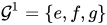
with source an range maps

can be visualized as the image on the right.
Ultragraph algebras
Given an ultragraph , we define to be the smallest subset of containing the singleton sets , containing the range sets , and closed under intersections, unions, and relative complements. A Cuntz–Krieger -family is a collection of projections together with a collection of partial isometries with mutually orthogonal ranges satisfying


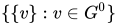
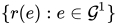

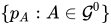
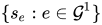
- , , for all ,
- for all ,
- whenever is a vertex that emits a finite number of edges, and
- for all .





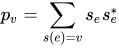


The ultragraph C*-algebra is the universal C*-algebra generated by a Cuntz–Krieger -family.



