Umm ar-Rasas mosaics
From Wikipedia, the free encyclopedia


The Umm ar-Rasas mosaics are a number of Byzantine mosaics discovered by Michele Piccirillo in the ruins of the Church of St. Stephen in Umm ar-Rasas, Jordan, in 1986.[1][2]
Of particular note is a mosaic floor dated to 785, the largest one in Jordan, with a series of panels depicting the most important cities of the region.
Outer frame, left (northern) side
A series of eight cities in Palestine are shown in the frame:
- Jerusalem (Hagia-polis [Holy City])
- Nablus (Neapolis)
- Sebastia (Sebastis)
- Caesarea
- Lydda (Diospolis)
- Bayt Jibrin (Eleutheropolis)
- Ascalon (Askalon)
- Gaza
 Jerusalem
 Nablus
 Sebastia
 Caesarea
 Lydda
Lydda Eleutheropolis (Bayt Jibrin)
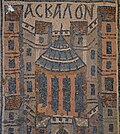 Ashkelon
 Gaza
Gaza


,_Um_er-Rasas,_Jordan.jpg)
,_Um_er-Rasas,_Jordan.jpg)

Outer frame, right (southern) side
Seven cities in Transjordan are shown in the frame:
- Kastron Mefaa (Umm er-Rasas)
- Philadelphia (Amman)
- Madaba
- Esbounta (Heshbon)
- Belemounta (Ma'in)
- Areopolis (Rabba)
- Charachmoba (Al-Karak)
Two additional cities are shown at the head of each aisle:
- Limbon
- Diblaton

,_Um_er-Rasas,_Jordan.jpg)

,_Um_er-Rasas,_Jordan.jpg)

Inner frame
The inner frame includes illustrations of ten cities in the Nile Delta:
- Alexandria
- Kasin (Ras Kouroun)
- Thenesos
- Tamiathis
- Panau
- Pelusium
- Anticiaou(?)
- Eraklion (either Heracleopolis Parva / Sethroë or Heracleion)
- Cynopolis
- Pseudostomon.
 Alexandria
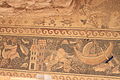 Kasin (Ras Kouroun)
 Thenesos
 Tamiathis
 Panau
Panau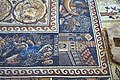
 Anticiaou(?)
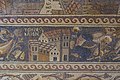 Eraklion
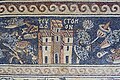 Pseudostomon


See also
- Early Byzantine mosaics in the Middle East; although dating to the Abbasid period, the mosaics there are part of the Byzantine tradition