Universal chord theorem
From Wikipedia, the free encyclopedia

In mathematical analysis, the universal chord theorem states that if a function f is continuous on [a,b] and satisfies , then for every natural number , there exists some such that .[1]


![{\displaystyle x\in [a,b]}](https://wikimedia.org/api/rest_v1/media/math/render/svg/026357b404ee584c475579fb2302a4e9881b8cce)
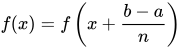
The theorem was published by Paul Lévy in 1934 as a generalization of Rolle's theorem.[2]
Statement of the theorem
Let denote the chord set of the function f. If f is a continuous function and , then for all natural numbers n. [3]



Case of n = 2
The case when n = 2 can be considered an application of the Borsuk–Ulam theorem to the real line. It says that if is continuous on some interval with the condition that , then there exists some such that .

![{\displaystyle I=[a,b]}](https://wikimedia.org/api/rest_v1/media/math/render/svg/6d6214bb3ce7f00e496c0706edd1464ac60b73b5)
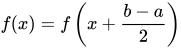
In less generality, if is continuous and , then there exists that satisfies .
![{\displaystyle f:[0,1]\rightarrow \mathbb {R} }](https://wikimedia.org/api/rest_v1/media/math/render/svg/29d08e15410d8d326f4ee95edfa4816f4794cf2c)

![{\displaystyle x\in \left[0,{\frac {1}{2}}\right]}](https://wikimedia.org/api/rest_v1/media/math/render/svg/b399d29f6843914b745aca4719f9f6b2192904b1)

Proof of n = 2
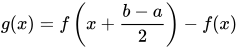
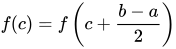
Consider the function defined by . Being the sum of two continuous functions, is continuous, . It follows that and by applying the intermediate value theorem, there exists such that , so that . This concludes the proof of the theorem for .
![{\displaystyle g:\left[a,{\dfrac {b+a}{2}}\right]\to \mathbb {R} }](https://wikimedia.org/api/rest_v1/media/math/render/svg/c591364e46f0d3d84761afb9c0620805e9ed6bc5)


![{\displaystyle c\in \left[a,{\dfrac {b+a}{2}}\right]}](https://wikimedia.org/api/rest_v1/media/math/render/svg/6a841d30dc022ed822cca1ddb91802f91cf8db57)


![{\displaystyle g:\left[a,b-{\dfrac {b-a}{n}}\right]\to \mathbb {R} }](https://wikimedia.org/api/rest_v1/media/math/render/svg/7cc7a0e7a160a922ece73957d660ecdc4c224ea8)
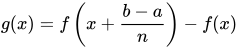
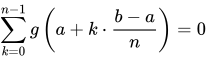



![{\displaystyle f:[0,1]\to \mathbb {R} }](https://wikimedia.org/api/rest_v1/media/math/render/svg/2de6d0d4c98d4ca7ad937c772dc3e3e914b062f5)



![{\displaystyle x\in [0,1]}](https://wikimedia.org/api/rest_v1/media/math/render/svg/64a15936df283add394ab909aa7a5e24e7fb6bb2)


