Although equations similar to Kepler's equation can be derived for parabolic and hyperbolic orbits, it is more convenient to introduce a new independent variable to take the place of the eccentric anomaly  and having a single equation that can be solved regardless of the eccentricity of the orbit. The new variable
  is defined by the following differential equation:

- where
 is the time-dependent scalar distance to the center of attraction.
(In all of the following formulas, carefully note the distinction between scalars  in italics, and vectors
  in upright bold.)
We can regularize the fundamental equation
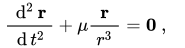
- where
 is the system gravitational scaling constant,
by applying the change of variable from time  to which yields[2]
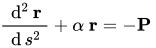
where  is some t.b.d. constant vector and :
  is the orbital energy, defined by

The equation is the same as the equation for the harmonic oscillator, a well-known equation in both physics and mathematics, however, the unknown constant vector is somewhat inconvenient. Taking the derivative again, we eliminate the constant vector  at the price of getting a third-degree differential equation:
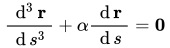
The family of solutions to this differential equation[2] are for convenience written symbolically in terms of the three functions 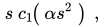
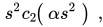 and
and 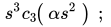 where the functions
  called Stumpff functions, which are truncated generalizations of sine and cosine series. The change-of-variable equation
  gives the scalar integral equation

After extensive algebra and back-substitutions, its solution results in[2]: Eq. 6.9.26

which is the universal variable formulation of Kepler's equation.
There is no closed analytic solution, but this universal variable form of Kepler's equation can be solved numerically for  using a root-finding algorithm such as Newton's method or Laguerre's method for a given time
  The value of so-obtained is then used in turn to compute the
  and
and  functions and the
  and
and  functions needed to find the current position and velocity:
![{\displaystyle {\begin{aligned}\ f(s)&=1-\left({\frac {\ \mu \ }{~r_{\mathsf {o}}\ }}\right)s^{2}c_{2}\!\!\left(\ \alpha s^{2}\ \right)\ ,\\[1.5ex]\ g(s)&=t-t_{\mathsf {o}}-\mu \ s^{3}c_{3}\!\!\left(\ \alpha s^{2}\ \right)\ ,\\[1.5ex]\ {\dot {f}}(s)\equiv {\frac {\ \operatorname {d} f\ }{\ \operatorname {d} t\ }}&=-\left({\frac {\ \mu \ }{\ r_{\mathsf {o}}r\ }}\right)s\ c_{1}\!\!\left(\ \alpha s^{2}\ \right)\ ,\\[1.5ex]\ {\dot {g}}(s)\equiv {\frac {\ \operatorname {d} g\ }{\ \operatorname {d} t\ }}&=1-\left({\frac {\ \mu \ }{r}}\right)\ s^{2}c_{2}\!\!\left(\ \alpha s^{2}\ \right)~.\\[-1ex]\end{aligned}}}](https://wikimedia.org/api/rest_v1/media/math/render/svg/78cb59f8aa785c6be9a5b065d779215fd7fe1dd0)
The values of the and functions determine the position of the body at the time :

In addition the velocity of the body at time can be found using  and
and  as follows:

- where
 and
and  are respectively the position and velocity vectors at time
  and
and  and
and
 are the position and velocity at arbitrary initial time

