| Year | Name | Image | Architect | Summary |
| 1937 | Gila Hall | | Roy Place | A three-story brick building on North Campus Drive with marked classical influence in its composition. Renaissance details, English Bond brickwork and use of terra cotta characterize the structure. The U-shaped building has sleeping porches at the ends of the projecting wings. |
| 1921 | Maricopa Hall |  | Lyman & Place | A two-story Classical Revival residence hall dominated by a flat-roofed portico featuring stylized concrete Corinthian columns. |
| 1937 | Yuma Hall | | Roy Place | The companion to Gila Hall, Yuma Hall shares a similar plan and massing but utilizes an Italian Romanesque Revival style instead. Variegated arched brickwork and gabled end pavilions featuring triple arch compositions characterize the building. |
| 1918 | Mines and Engineering Building | | J.B. Lyman | This "imposing" three-story building is highlighted by a recessed classical portico patterned after the Parthenon; it has a full entablature that spans the facade. |
| 1887-91 | Old Main (University Hall) |  | James Miller Creighton | Previously listed on the National Register in 1972. |
| 1919 | Berger Memorial Fountain | | Lyman & Place | see Old Main, University of Arizona |
| 1935 | Humanities Building | | Roy Place | A two-story brick classroom building in Italian Romanesque Revival style with details similar to Yuma Hall. Arches have spandrels featuring "Pueblo Deco" detailing. Now the Center for English as a Second Language. |
| 1909 | Science Hall | 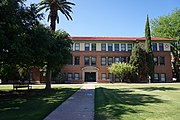 | D.H. and J.H. Holmes | A "vernacular classical" structure with the first two floors faced with brick and the third in stucco. Later housed the speech department and is now the Communication Building. |
| 1923-27 | University Library |  | Lyman & Place | Previously listed on the National Register in 1972. Now the North Building of the Arizona State Museum. |
| 1904 | Library and Museum Building |  | Russell, Mauran & Garden | Now the Douglass Building, a three-story Classical Revival building featuring two stories in brick and the top in stucco. The symmetrical façade uses excellent brickwork and double-hung window groupings. |
| 1936 | Centennial Hall (Main Auditorium) |  | Roy Place | This Italian Romanesque Revival auditorium uses large arched windows and entrance arches. |
| 1935 | Arizona State Museum (South Building) |  | Roy Place | The now-South Building of the Arizona State Museum combines Italian and Spanish Romanesque Revival elements. |
| 1920 | Cochise Hall |  | Lyman & Place | A symmetrical Classical Revival dormitory dominated by its elevated six-column prostyle Corinthian portico. |
| 1913 | Arizona Hall | | D.H. Holmes | A Classical Revival dormitory with a prostyle portico that uses square brick piers, not columns. A U-shaped building with sleeping porches surrounding a courtyard on three sides. |
| 1903 | Herring Hall | | D.H. Holmes | At the end of South Campus Drive, the university's first gymnasium, named for Col. William Herring who donated the majority of the building costs. A small Roman Revival building with a prostyle portico and arched entrance. |
| 1915 | Agriculture Building | | Lyman & Bristow | The principal façade of this building is dominated by a recessed octastyle portico utilizing Ionic columns. |
| 1937 | Administration Building |  | Roy Place | Now the Nugent Building, a three-story Italian Romanesque Revival building with a gabled central pavilion and two two-story wings. |
| 1936 | Chemistry-Physics Building |  | Roy Place | A two-story red brick building in Italian Romanesque Revival style but with two main entrances utilizing classical details. A compatible addition was built in 1948 but is not a contributing property. |
| 1921 | Steward Observatory | 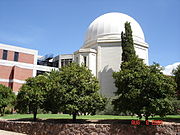 | Lyman & Place | A small octagonal building of white glazed terra cotta bricks, topped by a ribbed hemispherical dome. Several elements removed in 1958 when the new astronomy building was connected to it. |
| 1916 | Rock Wall | | | A wall of basalt rock quarried from local mountains, 4700 feet in length, that delineates the original campus boundaries. The main entrance incorporates wrought iron gates, a gift of the City of Prescott. |


.jpg)
.jpg)
.jpg)
.jpg)
.jpg)
.jpg)

.jpg)
.jpg)


