User:JPRiley/Dwight
From Wikipedia, the free encyclopedia
Benjamin F. Dwight was an American architect practicing in Boston, Massachusetts.
 | This is not a Wikipedia article: It is an individual user's work-in-progress page, and may be incomplete and/or unreliable. For guidance on developing this draft, see Help:Userspace draft § Creation. Find sources: Google (books · news · scholar · free images · WP refs) · FENS · JSTOR · TWL |
Life and career
Benjamin Franklin Dwight was born September 5, 1824 in Boston, to John and Mary (Corey) Dwight.[1] Dwight was educated at the Boston Latin School, graduating in 1844.[2] After a brief stint in the mercantile trade, he entered the office of architect George Snell as a student, and later became his chief assistant. Dwight was with Snell when Snell was designing the Boston Music Hall. Snell left soon after the building contracts were signed, embarking on a research trip to England. Dwight supervised construction of the foundations in his absence.[3]
After the Music Hall was completed Dwight left Snell to etablish his own practice.[3] He then joined the office of Arthur Gilman in 1854. This partnership lasted only until 1855, and Dwight returned to his own practice. He continued to work up until his death, which occured in Boston in 1893.[4]
Dwight was elected to fellowship in the Boston Society of Architects in 1867, which became affiliated with the American Institute of Architects in 1870. He retired from the organization in 1879.[5]
Personal life
Dwight was in ill health for much of his life, and in his later career this required him to scale back his practice.[4]
Dwight was the younger brother of John Sullivan Dwight,[1] the influential music critic and publisher of Dwight's Journal of Music. Dwight and his family were descendants of John Dwight, who immigrated to Massachusetts in 1635.[1]
Legacy
From before 1862 and from 1865 to 1870, John A. Fox was employed in Dwight's office.[6]
Architectural works
- Exeter Town Hall,[a][b] Exeter, New Hampshire (1855)[7]
- Allston Hall,[c] Boston, Massachusetts (1859, demolished 1922)[8]
- House for Lewis Day, Norwood, Massachusetts (1859, altered 1890-92, NRHP 1977)[9]
- 266 Washington Street building, Boston, Massachusetts (1864, demolished 1901)[10][11]
- Gloucester City Hall,[d] Gloucester, Massachusetts (1866-68, burned 1869)[12]
- "Homestead" for Benjamin F. Butler, Annisquam, Massachusetts (1866-67)[12]
- Selwyn's Theatre, Boston, Massachusetts (1867, burned 1873)[13][14]
- Soldiers' Monument, Ashfield Plain Cemetery, Ashfield, Massachusetts (1867)[15]
- Soldiers' Monument, Allen Park, Dorchester, Boston, Massachusetts (1867)[16]
- National Home for Disabled Volunteer Soldiers, Eastern Branch,[e] Togus, Maine (1868-69, mostly demolished)[17]
- "Oak View" for Francis O. Winslow, Norwood, Massachusetts (1868)[18]
- Worcester Music Hall,[f] Worcester, Massachusetts (1869, burned 1889)[19]
- Berkeley Hotel, Boston, Massachusetts (1870, demolished 1905)[20][4]
- Kenduskeag Block, Bangor, Maine (1870, burned 1911)[21]
- 227 Tremont Street building, Boston, Massachusetts (1873, demolished)[22]
- Globe Theatre, Boston, Massachusetts (1873-74, burned 1894)[4]
- 28 Avery Street building, Boston, Massachusetts (1874-75, demolished)[23]
- Hathaway Building, Boston, Massachusetts (1887-88, demolished)[24]
- Sheldon Building, Boston, Massachusetts (1891-92, demolished)[24]
Gallery of architectural works
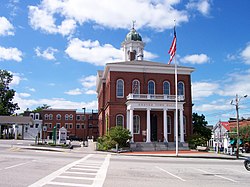 Exeter Town Hall, Exeter, New Hampshire, 1855.
 266 Washington Street building (right), Boston, Massachusetts, 1864.
 Soldiers' Monument, Allen Park, Dorchester, Boston, Massachusetts, 1867.
 General view, National Home for Disabled Volunteer Soldiers, Togus, Maine, 1868-69.
 Governor's House, National Home for Disabled Volunteer Soldiers, Togus, Maine, 1868-69.
 Globe Theatre, Boston, Massachusetts, 1873-74.

.jpg)

_(14782056571).jpg)


Notes
- Credited to the partnership of Gilman & Dwight.
- A contributing property to the Front Street Historic District, NRHP-listed in 1973.
- Later known as the New Tremont Theatre and incorporated into the Studio Building in 1865.
- Replaced by a building designed by Bryant & Rogers.
- Though mostly demolished during the 1930s, the Governor's House, designed by Dwight, is still standing and was NRHP-listed in 1974.
- Later known as the Worcester Theatre.