User:Vanadiumfour/sandbox/Graphite
Allotrope of carbon, mineral, substance
From Wikipedia, the free encyclopedia
~~Work in progress~~
Status: Not done
 Doing...
Last updated: 2025-02-11
 | This page is a draft to replace the mainspace graphite article once it has been completed |
 | This is a draft article. It is a work in progress open to editing by anyone. Please ensure core content policies are met before publishing it as a live Wikipedia article. Find sources: Google (books · news · scholar · free images · WP refs) · FENS · JSTOR · TWL Last edited by Vanadiumfour (talk | contribs) 13 months ago. (Update) |

| Graphite | |
|---|---|
 Graphite specimen | |
| General | |
| Category | Native mineral |
| Formula | C |
| IMA symbol | Gr[1] |
| Strunz classification | 1.CB.05a |
| Crystal system | Hexagonal or Rhombohedral |
| Crystal class | Dihexagonal dipyramidal (6/mmm) Hermann–Mauguin notation: (6/m 2/m 2/m) |
| Space group | P63mc (buckled) P63/mmc (flat) |
| Unit cell | a = 2.461, c = 6.708 [Å]; Z = 4 |
| Identification | |
| Color | Iron-black to steel-gray; deep blue in transmitted light |
| Crystal habit | Tabular, six-sided foliated masses, granular to compacted masses |
| Twinning | Present |
| Cleavage | Basal – perfect on {0001} |
| Fracture | Flaky, otherwise rough when not on cleavage |
| Tenacity | Flexible non-elastic, sectile |
| Mohs scale hardness | 1–2 |
| Luster | Metallic, earthy |
| Streak | Black |
| Diaphaneity | Opaque, transparent only in extremely thin flakes |
| Specific gravity | 1.9–2.3 |
| Density | 2.09–2.23 g/cm3 |
| Optical properties | Uniaxial (−) |
| Pleochroism | Strong |
| Solubility | Soluble in molten nickel, warm chlorosulfuric acid[2] |
| Other characteristics | strongly anisotropic, conducts electricity, greasy feel, readily marks |
| References | [3][4][5] |
Graphite (/ˈɡræfaɪt/) is a crystalline allotrope (form) of the element carbon. It consists of many stacked layers of graphene typically in the excess of hundred(s) of layers. Graphite occurs naturally and is the most stable form of carbon under standard conditions. Synthetic and natural graphite are consumed on a large scale (1.3 million metric tons per year in 2022)[6] for uses in many critical industries including refractories (50%), lithium-ion batteries (18%), foundries (10%), lubricants (5%), among others (17%)[7]. You can see the breakout for 2019 in the market end use figure[8]. Under extremely high pressures and extremely high temperatures it converts to diamond. It is a good conductor of both heat [9] and electricity.[9]

JournalCitationExample[10]
Definition
Graphite Structure and Properties
Structure

Graphite, an allotrope of carbon, is composed of stacked graphene layers in a 3D crystalline lattice. Each carbon atom of the layer is covalently bonded to three other carbon atoms forming a continuous layer of sp2 bonded carbon hexagons. Each carbon atom is centered in a hexagon in the layers adjacent allowing the interlayer spacing to be close in a pattern of either ABAB (hexagonal or alpha) or ABCABC (rhombohedral or beta) stacking structure. Each 2D layers or sheets are held together through the relatively weak van der Waals forces forming the 3D crystalline structure. Typically, graphite has some degree of turbostratic disorder characterized by graphene sheets that are translated, rotated, or otherwise defective in alignment leading to imperfections in layer stacking leading to larger spacing between the graphene layers along the cystalline c-axis.
Types and Varieties Overview
Occurrence
Outside of ongoing research and new techniques, Graphite comes in one of two primary forms: Natural or Synthetic wherin Natural Graphite is obtained from naturally occuring geologic deposits and Synthetic Graphite is produced through human activity.
Natural graphite
Graphite occurs naturally in ores that can be classified into one of two categories either amorphous (microcrystalline) or crystalline (flake or lump/chip) which is determined by the ore morphology, crystallinity, and grain size. [9] All naturally occurring graphite deposits are formed from the metamorphism of carbonaceous sedimentary rocks, and the ore type is due to its geologic setting. Coal that has been thermally metamorphosed is the typical source of amorphous graphite. Crystalline flake graphite is mined from carbonaceous metamorphic rocks, while lump or chip graphite is mined from veins which occur in high-grade metamorphic regions.[9] There are serious negative environmental impacts to graphite mining.
Synthetic graphite
Synthetic graphite is graphite of high purity produced by thermal graphitization at temperatures in excess of 2,100 °C from hydrocarbon materials most commonly by a process known as the Acheson process.[9][11] The high temperatures are maintained for weeks, and are required not only to form the graphite from the precursor carbons but to also vaporize any impurities that may be present, including hydrogen, nitrogen, sulfur, organics, and metals.[9] This is why synthetic graphite is highly pure in excess of 99.9% C purity, but typically has lower density, conductivity and a higher porosity than its natural equivalent.[9] Synthetic graphite can also be formed into very large flakes (cm) while maintaining its high purity unlike almost all sources of natural graphite.[9] Synthetic graphite has also been known to be formed by other methods including by chemical vapor deposition from hydrocarbons at temperatures above 2,500 K (2,230 °C), by decomposition of thermally unstable carbides or by crystallizing from metal melts supersaturated with carbon.[12]
Research
Continuing research and development into new methods of industrial production of graphite for a variety of applications including lithium-ion batteries, refractories, foundries, among others. Significant work has been done on the graphitizing of traditionally non-graphitizable carbons. A company in New Zealand utilizes forestry waste to produce what they have termed 'biographite' through a process referred to as thermo-catalytic graphitization.[13][14] Annother group in the United States uses a method referred to as photocatalytic graphitization to produce highly crystalline highly pure graphite for lithium-ion batteries and other applications from a variety of carbon sources.[10][15]
Natural Graphite
Synthetic Graphite
Uses of Graphite
Graphite History
See Also
Sources
References
Further Reading
External Links
Natural graphite
Occurrence
Graphite occurs in metamorphic rocks as a result of the reduction of sedimentary carbon compounds during metamorphism. It also occurs in igneous rocks and in meteorites.[5] Minerals associated with graphite include quartz, calcite, micas and tourmaline. The principal export sources of mined graphite are in order of tonnage: China, Mexico, Canada, Brazil, and Madagascar.[16] Significant unexploited graphite resources also exists in Colombia's Cordillera Central in the form of graphite-bearing schists.[17]
In meteorites, graphite occurs with troilite and silicate minerals.[5] Small graphitic crystals in meteoritic iron are called cliftonite.[18] Some microscopic grains have distinctive isotopic compositions, indicating that they were formed before the Solar System.[19] They are one of about 12 known types of minerals that predate the Solar System and have also been detected in molecular clouds. These minerals were formed in the ejecta when supernovae exploded or low to intermediate-sized stars expelled their outer envelopes late in their lives. Graphite may be the second or third oldest mineral in the Universe.[20][21]
Structure
Graphite consists of sheets of trigonal planar carbon.[22][23] The individual layers are called graphene. In each layer, the carbon atoms are arranged in a honeycomb lattice with a bond length of 0.142 nm, and the distance between planes is 0.335 nm.[24] Bonding between layers is relatively weak van der Waals bonds, which allows the graphene-like layers to be easily separated and to glide past each other.[25] Electrical conductivity perpendicular to the layers is consequently about 1000 times lower.[26]
There are two allotropic forms called alpha (hexagonal) and beta (rhombohedral), differing in terms of the stacking of the graphene layers: stacking in alpha graphite is ABA, as opposed to ABC stacking in the energetically less stable beta graphite. Rhombohedral graphite cannot occur in pure form.[27] Natural graphite, or commercial natural graphite, contains 5 to 15% rhombohedral graphite[28] and this may be due to intensive milling.[29] The alpha form can be converted to the beta form through shear forces, and the beta form reverts to the alpha form when it is heated to 1300 °C for four hours.[28][27]
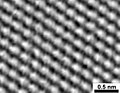 Scanning tunneling microscope image of graphite surface
 Side view of ABA layer stacking
 Plane view of layer stacking
 Alpha graphite's unit cell


Thermodynamics

The equilibrium pressure and temperature conditions for a transition between graphite and diamond is well established theoretically and experimentally. The pressure changes linearly between 1.7 GPa at 0 K and 12 GPa at 5000 K (the diamond/graphite/liquid triple point).[30][31] However, the phases have a wide region about this line where they can coexist. At normal temperature and pressure, 20 °C (293 K) and 1 standard atmosphere (0.10 MPa), the stable phase of carbon is graphite, but diamond is metastable and its rate of conversion to graphite is negligible.[32] However, at temperatures above about 4500 K, diamond rapidly converts to graphite. Rapid conversion of graphite to diamond requires pressures well above the equilibrium line: at 2000 K, a pressure of 35 GPa is needed.[30]
Other properties

The acoustic and thermal properties of graphite are highly anisotropic, since phonons propagate quickly along the tightly bound planes, but are slower to travel from one plane to another. Graphite's high thermal stability and electrical and thermal conductivity facilitate its widespread use as electrodes and refractories in high temperature material processing applications. However, in oxygen-containing atmospheres graphite readily oxidizes to form carbon dioxide at temperatures of 700 °C and above.[33]
Graphite is an electrical conductor, hence useful in such applications as arc lamp electrodes. It can conduct electricity due to the vast electron delocalization within the carbon layers (a phenomenon called aromaticity). These valence electrons are free to move, so are able to conduct electricity. However, the electricity is primarily conducted within the plane of the layers. The conductive properties of powdered graphite[34] allow its use as pressure sensor in carbon microphones.
Graphite and graphite powder are valued in industrial applications for their self-lubricating and dry lubricating properties. However, the use of graphite is limited by its tendency to facilitate pitting corrosion in some stainless steel,[35][36] and to promote galvanic corrosion between dissimilar metals (due to its electrical conductivity). It is also corrosive to aluminium in the presence of moisture. For this reason, the US Air Force banned its use as a lubricant in aluminium aircraft,[37] and discouraged its use in aluminium-containing automatic weapons.[38] Even graphite pencil marks on aluminium parts may facilitate corrosion.[39] Another high-temperature lubricant, hexagonal boron nitride, has the same molecular structure as graphite. It is sometimes called white graphite, due to its similar properties.
When a large number of crystallographic defects bind these planes together, graphite loses its lubrication properties and becomes what is known as pyrolytic graphite. It is also highly anisotropic, and diamagnetic, thus it will float in mid-air above a strong magnet. (If it is made in a fluidized bed at 1000–1300 °C then it is isotropic turbostratic, and is used in blood-contacting devices like mechanical heart valves and is called pyrolytic carbon, and is not diamagnetic. Pyrolytic graphite and pyrolytic carbon are often confused but are very different materials.[40])
Natural and crystalline graphites are not often used in pure form as structural materials, due to their shear-planes, brittleness, and inconsistent mechanical properties.
See also
Sources
 This article incorporates text from a free content work. Licensed under CC-BY. Text taken from Patent Landscape Report - Graphite and its applications, WIPO.

