VAG Class DT1
From Wikipedia, the free encyclopedia
| VAG Class DT1 | |
|---|---|
 A DT1 train in service on line U1 in June 2016 | |
| Manufacturer | MAN |
| Constructed | 1970–1984 |
| Scrapped | 2010-2023 |
| Number built | 128 vehicles (64 sets) |
| Number scrapped | 24 vehicles (12 sets) |
| Successor | G1 |
| Formation | 2 cars per trainset |
| Fleet numbers | 401/402–527/528 |
| Capacity | 290 (98 seated) |
| Operator | VAG |
| Specifications | |
| Car body construction | Aluminium |
| Train length | 36,550 mm (119 ft 11 in) |
| Width | 2,900 mm (9 ft 6 in) |
| Height | 3,550 mm (11 ft 8 in) |
| Doors | 3 pairs per side |
| Maximum speed | 80 km/h (50 mph) |
| Weight | 51.7 t |
| Traction system | Direct current resistor control (1970-1980), three-phase chopper control (1980-1984) |
| Power output | 720 kW (DC drive version) 800 kW (Three-phase version) |
| Electric system | 750 V DC Third rail |
| Current collection | contact shoe pantograph (maintenance only) |
| Braking systems | Electric brake, pneumatic brake, spring accumulator brake, magnetic track brake |
| Track gauge | 1,435 mm (4 ft 8+1⁄2 in) |
The VAG Class DT1 (colloquially called "Pegnitzpfeil"[1]) is an electric multiple unit (EMU) train type operated by the Verkehrs-Aktiengesellschaft Nürnberg on the Nuremberg U-Bahn system from its opening in 1972 until 2023. It is a derivative of the MVG Class A, in service on the Munich U-Bahn since 1971.[2][3]
Interior
Seating accommodation consists of transverse seating bays. Passengers can look into the adjacent car through two windows in the inner car end.[2]
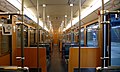 Interior view

Technical specifications
The design is derived from the MVG Class A. Differences include a magnetic track brake system, that is missing from Munich's Class A trains.[3][2] The car bodies are made out of aluminium, and the trains are powered by direct current motors. Beginning with units 465/466, built from 1980 until the end of production in 1984, the trains were delivered with three-phase motors.[2] Besides the power supply by contact shoes, every unit is also equipped with a pantograph, as parts of the maintenance facilities are electrified with overhead lines.[2][1]


