Vallejimeno
From Wikipedia, the free encyclopedia
Vallejimeno
Vallegimeno | |
|---|---|
 Aerial view of the village Vallejimeno | |
 Flag | |
 Interactive map of Vallejimeno | |
| Coordinates: 42°07′3.09″N 3°11′4.93″W / 42.1175250°N 3.1847028°W | |
| Country | Spain |
| Province | Burgos |
| Comarca | Sierra de la Demanda |
| Municipality | Valle de Valdelaguna |
| Population (2024) | |
• Total | 11 |
| Website | Vallejimeno (Valle de Valdelaguna) |
Vallejimeno (Spanish pronunciation: [bˌaʎeximˈeno]), also known as Vallegimeno,[1] is a locality belonging to the municipality of Valle de Valdelaguna, inside the province of Burgos, autonomous community of Castile and León (Spain).[2] It belongs to the comarca of Sierra de la Demanda and to the judicial district of Salas de los Infantes. According to the 2024 census (INE), Vallejimeno has a population of 11 inhabitants.[3]
The toponym refers to the medieval compound name Vallejimeno, translated as "valley of Jimeno," combining the Latin vallis ("valley") with the anthroponym Jimeno (also written Gimeno). Its etymology is debated: a Basque theory links it to Semeno, derived from seme ("son");[4] a Hebraic-Latin theory connects it to Simeno, a variant of Simon meaning "he has heard".[5] The settlement is first documented in 932 in a donation to the Monastery of San Pedro de Arlanza during the Reconquista and as part of the repopulation of the County of Castile during the 9th century and 10th centuries.[6]
The village's heritage includes the San Martín Obispo Church, built in the 17th century, notable for its Romanesque baptismal font and Baroque altarpieces.[7] Located outside the village centre is the Hermitage of Santa María. It also features the so-called Romano and Medieval bridges over the Tejero River, which divides Vallejimeno into two neighborhoods; despite their names, their exact dates of construction are not documented. Several houses in the village constitute examples of traditional rural architecture, historically linked to livestock-owning households in the area.[7] The surrounding territory also includes dehesas associated with traditional agrosilvopastoral land use, in addition to the beech and oak forests characteristic of the Sierra de la Demanda.[7] Among the area's natural features is the “Quejigo Bonito”, a singular oak listed in the provincial catalogue of notable trees.[8]
- Gallery
 Vallejimeno from the south
 Vallejimeno from the west
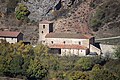 Church of San Martín Obispo
 Hermitage of Santa María
 Medieval Bridge
 Romano Bridge


