Van Laar derived the excess enthalpy from the van der Waals equation:[1]

In here ai and bi are the van der Waals parameters for attraction and excluded volume of component i. He used the conventional quadratic mixing rule for the energy parameter a and the linear mixing rule for the size parameter b.
Since these parameters didn't lead to good phase equilibrium description the model was reduced to the form:
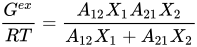
In here A12 and A21 are the van Laar coefficients, which are obtained by regression of experimental vapor–liquid equilibrium data.
The activity coefficient of component i is derived by differentiation to xi. This yields:
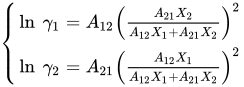
This shows that the van Laar coefficients A12 and A21 are equal to logarithmic limiting activity coefficients  and
and  respectively. The model gives increasing (A12 and A21 >0) or only decreasing (A12 and A21 <0) activity coefficients with decreasing concentration. The model can not describe extrema in the activity coefficient along the concentration range.
In case  , which implies that the molecules are of equal size but different in polarity, then the equations become:
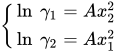
In this case the activity coefficients mirror at x1=0.5. When A=0, the activity coefficients are unity, thus describing an ideal mixture.
An extensive range of recommended values for the Van Laar coefficients can be found in the literature.[2][3] Selected values are provided in the table below.
| System |
A12 |
A21 |
|---|
| Acetone(1)-Chloroform(2)[3] |
-0.8643 |
-0.5899 |
| Acetone(1)-Methanol(2)[3] |
0.6184 |
0.5797 |
| Acetone(1)-Water(2)[3] |
2.1041 |
1.5555 |
| Carbon tetrachloride(1)-Benzene (2)[3] |
0.0951 |
0.0911 |
| Chloroform(1)-Methanol(2)[3] |
0.9356 |
1.8860 |
| Ethanol(1)-Benzene(2)[3] |
1.8570 |
1.4785 |
| Ethanol(1)-Water(2)[3] |
1.6798 |
0.9227 |