Variable elimination
From Wikipedia, the free encyclopedia
Variable elimination (VE) is a simple and general exact inference algorithm in probabilistic graphical models, such as Bayesian networks and Markov random fields.[1] It can be used for inference of maximum a posteriori (MAP) state or estimation of conditional or marginal distributions over a subset of variables. The algorithm has exponential time complexity, but could be efficient in practice for low-treewidth graphs, if the proper elimination order is used.
Enabling a key reduction in algorithmic complexity, a factor , also known as a potential, of variables is a relation between each instantiation of of variables to a non-negative number, commonly denoted as .[2] A factor does not necessarily have a set interpretation. One may perform operations on factors of different representations such as a probability distribution or conditional distribution.[2] Joint distributions often become too large to handle as the complexity of this operation is exponential. Thus variable elimination becomes more feasible when computing factorized entities.


Basic Operations
Variable Summation
Algorithm 1, called sum-out (SO), or marginalization, eliminates a single variable from a set of factors,[3] and returns the resulting set of factors. The algorithm collect-relevant simply returns those factors in involving variable .

Algorithm 1 sum-out(,)
- = collect factors relevant to
- = the product of all factors in


return
Example
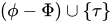
Here we have a joint probability distribution. A variable, can be summed out between a set of instantiations where the set at minimum must agree over the remaining variables. The value of is irrelevant when it is the variable to be summed out.[2]

| true | true | true | false | false | 0.80 |
| false | true | true | false | false | 0.20 |


After eliminating , its reference is excluded and we are left with a distribution only over the remaining variables and the sum of each instantiation.
| true | true | false | false | 1.0 |
The resulting distribution which follows the sum-out operation only helps to answer queries that do not mention .[2] Also worthy to note, the summing-out operation is commutative.
Factor Multiplication
Computing a product between multiple factors results in a factor compatible with a single instantiation in each factor.[2]
Algorithm 2 mult-factors(,)[2]
- = Union of all variables between product of factors
- = a factor over where for all
- For each instantiation
- For 1 to
- instantiation of variables consistent with
- For 1 to
- return





Factor multiplication is not only commutative but also associative.


