Viridian
Shade of bluish green
From Wikipedia, the free encyclopedia
Viridian is a blue-green pigment, a hydrated chromium(III) oxide, of medium saturation and relatively dark in value. It is composed of a majority of green, followed by blue. The first recorded use of viridian as a color name in English was in the 1860s.[2] Viridian takes its name from the Latin viridis, meaning "green".[3] The pigment was first prepared in mid-19th-century Paris and remains available from several US manufacturers as prepared artists' colors in all media.[4]: 276–77
-oxide-sample.jpg)

_(Left)_And_Phthalocyanine_Green(Pigment_Green_7)_(Right)_Gouache.jpg)
History
Viridian pigment was first prepared in 1838 in Paris by Parisian color chemist and painter Pannetier alongside his assistant Binet as a hydrated form of chromium oxide.[5][6] The preparation process was demanding, expensive, and shrouded in secrecy.[4]: 275 The French chemist C. E. Guignet developed and patented a cheaper manufacturing method in 1859 that enabled larger distribution and use of the pigment.[4]: 274 This method involved calcining a combination of boric acid and potassium bichromate, then washing the material.[4]: 280–281
Winsor and Newton's catalogue listed the pigment as early as 1849. It was used as early as 1840 in a work by J. M. W. Turner.[4]: 275 Viridian was in prominent use by the mid-nineteenth century, but was less popular than three to four times more affordable alternatives including emerald and chrome greens.[4]: 276–77
Visual characteristics
Viridian is a bright shade of spring green, which places the color between green and teal on the color wheel, or, in paint, a tertiary blue–green color. Viridian is dark in value, has medium saturation, and is transparent.[4]: 275
Variations of viridian
Paolo Veronese green
Paolo Veronese green is the color that is called verde veronés in the Guía de coloraciones (Guide to colorations) by Rosa Gallego and Juan Carlos Sanz, a color dictionary published in 2005 that is widely popular in the Hispanophone realm.
Paolo Veronese green was a color formulated and used by the noted 16th-century Venetian artist Paolo Veronese.
Paolo Veronese green began to be used as a color name in English sometime in the 1800s (exact year uncertain).[8]
Another name for this color is transparent oxide of chromium.[9]
Viridian green
At right is displayed the color viridian green.
The source of this color is the "Pantone Textile Paper eXtended (TPX)" color list, color #17-5126 TPX—Viridian Green.[11]
Generic viridian
Generic viridian is the color that is called Viridian inspecifico in the Guía de coloraciones (Guide to colorations) by Rosa Gallego and Juan Carlos Sanz, a color dictionary published in 2005 that is widely popular in the Hispanophone realm.
Spanish viridian
Spanish viridian is the color that is called Viridian specifico in the Guía de coloraciones (Guide to colorations) by Rosa Gallego and Juan Carlos Sanz, a color dictionary published in 2005 that is widely popular in the Hispanophone realm.
Permanence
Viridian is considered durable and permanent as an artist's pigment.[4]: 278 Viridian is unaffected by temperatures up to 260 °C (500 °F), but it is unsuitable for use in ceramic glazes.[4]: 278 Viridian is compatible with all pigments in all media, and has high oil absorption.[4]: 278 Pure pigment formulations of viridian are hard and may separate in tubes, but adding barium sulfate in small quantities enables easy grinding and dispersion.[4]: 278
Notable occurrences
| Viridian as a quaternary color on the RYB color wheel: |
green |
viridian |
teal |
Although viridian is not a frequent color name in English, it is used in a number of cultural references, probably because it is derived from viridis, the Latin word for green, so using the word viridian sounds more elegant than simply referring to the Old English word green.[citation needed]
Fine art painting
- Fritz Bamberger, Afterglow in the Sierra Nevada, 1863.[4]: 288
- Claude Monet, Arrival of the Normandy Train, Gare Saint-Lazare, 1877, oil on canvas[4]: 287 includes traces of viridian in the grassy area.
- Pierre-Auguste Renoir, Flowers, 1919.[4]: 288

Fritz Bamberger - Ansicht der Sierra Nevada, 1863. Bavarian State Painting Collections. 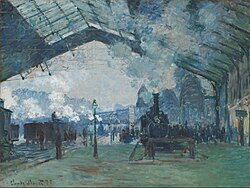
Claude Monet - Arrival of the Normandy Train, Gare Saint-Lazare, 1877, oil on canvas. Art Institute of Chicago. 
Renoir - Flowers, 1919.


Automobiles
Broadcasting
Environmental design
- The viridian design movement is a popular design movement based on a bright green environmentalism philosophy.[13][14]