Volterra operator
From Wikipedia, the free encyclopedia
In mathematics, in the area of functional analysis and operator theory, the Volterra operator, named after Vito Volterra, is a bounded linear operator on the space L2[0,1] of complex-valued square-integrable functions on the interval [0,1]. On the subspace C[0,1] of continuous functions it represents indefinite integration. It is the operator corresponding to the Volterra integral equations.
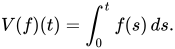
The Volterra operator, V, may be defined for a function f ∈ L2[0,1] and a value t ∈ [0,1], as[1]
Properties
- V is a bounded linear operator between Hilbert spaces, with kernel form proven by exchanging the integral sign.
- V is a Hilbert–Schmidt operator with norm , hence in particular is compact.
- Its Hermitian adjoint has kernel form
- The positive-definite integral operator has kernel formproven by exchanging the integral sign. Similarly, has kernel . They are unitarily equivalent via , so both have the same spectrum.
- The eigenfunctions of satisfy with solution with .
- The singular values of V are with .
- The operator norm of V is .
- V is not trace class.
- V has no eigenvalues and therefore, by the spectral theory of compact operators, its spectrum σ(V) = {0}.[2][3]
- V is a quasinilpotent operator (that is, the spectral radius, ρ(V), is zero), but it is not nilpotent operator.




