Waldsieversdorf
From Wikipedia, the free encyclopedia
Waldsieversdorf | |
|---|---|
 | |
 Coat of arms | |
Location of Waldsieversdorf within Märkisch-Oderland district 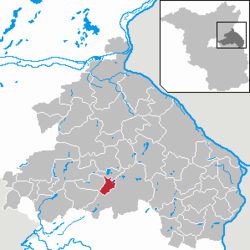 | |
  Waldsieversdorf  Waldsieversdorf | |
| Coordinates: 52°32′36″N 14°04′20″E / 52.54333°N 14.07222°E | |
| Country | Germany |
| State | Brandenburg |
| District | Märkisch-Oderland |
| Municipal assoc. | Märkische Schweiz |
| Government | |
| • Mayor (2024–29) | Rainer Bertram[1] |
| Area | |
• Total | 15.61 km2 (6.03 sq mi) |
| Elevation | 42 m (138 ft) |
| Population (2022-12-31)[2] | |
• Total | 851 |
| • Density | 55/km2 (140/sq mi) |
| Time zone | UTC+01:00 (CET) |
| • Summer (DST) | UTC+02:00 (CEST) |
| Postal codes | 15377 |
| Dialling codes | 033433 |
| Vehicle registration | MOL |
| Website | www.waldsieversdorf.info |
Waldsieversdorf is a municipality in the district Märkisch-Oderland of Brandenburg (a Land of the Federal Republic of Germany). As a government-recognized health and holiday resort, Waldsieversdorf is a part of the administrative division Amt Märkische Schweiz, of which Buckow is the seat of regional administration.
Waldsieversdorf is located in the middle of the Märkische Schweiz Nature Park almost two miles from the small town of Buckow. Because of the natural forest and lakes affluence it's a favourite place for excursions. Close to the place centre there is the lake Grosser Däbersee, a perfect place for swimming, fishing and boating. The municipality is flown through by the river Stobber.
History
The territory of Märkische Schweiz was already populated by the Teutons at the Bronze Age. This population emigrated in the 5th century. From 7th to 9th century there was a prehistoric fortification (de. Volksburg) the so-called “Schwedenschanze” of the Slavic tribes, who settled at the end of the 6th century over there. In 1253 villam Sifiridisdorp and Buckow were called for the first time in a bill of sale signed by the Archbishop of Magdeburg. In 1432 the village was burned to the ground by the Hussites on their campaign to Bernau. At the Thirty Years' War the Wüste Sieversdorf was pillaged by the Imperial Croatian Troops.
In 1889 Ferdinand Kindermann acquired the so-called Priest Mill (de. Priestermühle) in Wüste Sieversdorf together with 250 acre of soil. From 1895 there came into being a high-class suburb settlement, which has been connected with the small towns Müncheberg and Buckow by a local railway since 1897. In 1907 the place was finally renamed to Waldsieversdorf.
Until 1993 the Fernmeldeabteilung 14, a signal regiment-sized unit of the Bundeswehr was stationed in Waldsieversdorf at Rotes Luch (de).
Demography

|
|
Politics
Municipal council
The municipal council of Waldsieversdorf consists of 10 councillors (lady councillors) including the mayor (lady mayor).
| Year of elections | voter association: Non-party Citizen (de:WG Parteilose Bürger) | Single applicants | Total |
|---|---|---|---|
| 2008 | 4 | 6 | 10 mandates |
(As to September 18, 2008.)
Heraldic
The Waldsieversdorf Coat of arms was approved on August 18, 1995.
Flag
The municipal bears a red-white-read stripped flag with the municipal coat put on.


