Wall–Sun–Sun prime
Type of prime number conjectured to exist
From Wikipedia, the free encyclopedia
In number theory, a Wall–Sun–Sun prime or Fibonacci–Wieferich prime is a certain kind of prime number which is conjectured to exist, although none are known.
| Named after | Donald Dines Wall, Zhi Hong Sun and Zhi Wei Sun |
|---|---|
| Publication year | 1992 |
| No. of known terms | 0 |
| Conjectured no. of terms | Infinite |
Definition
Let be a prime number. When each term in the sequence of Fibonacci numbers is reduced modulo (i.e. subtracted by the largest multiple of less than it), the result is a periodic sequence. The (minimal) period length of this sequence is called the Pisano period and denoted . Since , it follows that p divides . A prime p such that p2 divides is called a Wall–Sun–Sun prime.


 ,
,  ...
...| p | Periodic sequence | Quotient of /p2 | ||
|---|---|---|---|---|
| 2 | 0, 1, 1 | 3 | 2 | 0.5 |
| 3 | 0, 1, 1, 2, 0, 2, 2, 1 | 8 | 21 | 2.3 |
| 5 | 0, 1, 1, 2, 3, 0, 3, 3, 1, 4, 0, 4, 4, 3, 2, 0, 2, 2, 4, 1 | 20 | 6,765 | 270.6 |
| 7 | 0, 1, 1, 2, 3, 5, 1, 6, 0, 6, 6, 5, 4, 2, 6, 1 | 16 | 987 | 20.142857 |
| 11 | 0, 1, 1, 2, 3, 5, 8, 2, 10, 1 | 10 | 55 | 0.45 |
A prime is a Wall–Sun–Sun prime if and only if the quotient of divided by p2 is a natural number.
Equivalent definitions
If denotes the rank of apparition modulo (i.e., is the smallest positive index such that divides ), then a Wall–Sun–Sun prime can be equivalently defined as a prime such that divides .


For a prime p ≠ 2, 5, the rank of apparition is known to divide , where the Legendre symbol has the values



This observation gives rise to an equivalent characterization of Wall–Sun–Sun primes as primes such that divides the Fibonacci number .[1]

A prime is a Wall–Sun–Sun prime if and only if .
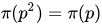
A prime is a Wall–Sun–Sun prime if and only if , where is the -th Lucas number.[2]: 42


McIntosh and Roettger establish several equivalent characterizations of Lucas–Wieferich primes.[3] In particular, let ; then the following are equivalent:





Existence
In a study of the Pisano period , Donald Dines Wall determined that there are no Wall–Sun–Sun primes less than . In 1960, he wrote:[4]


The most perplexing problem we have met in this study concerns the hypothesis . We have run a test on digital computer which shows that for all up to ; however, we cannot prove that is impossible. The question is closely related to another one, "can a number have the same order mod and mod ?", for which rare cases give an affirmative answer (e.g., ; ); hence, one might conjecture that equality may hold for some exceptional .
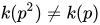




It has since been conjectured that there are infinitely many Wall–Sun–Sun primes.[5]
In 2007, Richard J. McIntosh and Eric L. Roettger showed that if any exist, they must be > 2×10¹⁴.[3] Dorais and Klyve extended this range to 9.7×10¹⁴ without finding such a prime.[6]
In December 2011, another search was started by the PrimeGrid project;[7] however, it was suspended in May 2017.[8] In November 2020, PrimeGrid started another project that searches for Wieferich and Wall–Sun–Sun primes simultaneously.[9] The project ended in December 2022, proving that any Wall–Sun–Sun prime must exceed (about ).[10]


History
Wall–Sun–Sun primes are named after Donald Dines Wall,[4][11] Zhi Hong Sun and Zhi Wei Sun; Z. H. Sun and Z. W. Sun showed in 1992 that if the first case of Fermat's Last Theorem was false for a certain prime p, then p would have to be a Wall–Sun–Sun prime.[12] As a result, prior to Wiles's proof of Fermat's Last Theorem, the search for Wall–Sun–Sun primes was also the search for a potential counterexample to this centuries-old conjecture.
Generalizations
A tribonacci–Wieferich prime is a prime p satisfying h(p) = h(p2), where h(m) is the least positive integer k satisfying [Tk,Tk+1,Tk+2] ≡ [T0, T1, T2] (mod m) and Tn denotes the n-th tribonacci number. No tribonacci–Wieferich prime exists below 1011.[13]
A Pell–Wieferich prime is a prime p satisfying p2 divides Pp−1, when p congruent to 1 or 7 (mod 8), or p2 divides Pp+1, when p congruent to 3 or 5 (mod 8), where Pn denotes the n-th Pell number. For example, 13, 31, and 1546463 are Pell–Wieferich primes, and no others below 109 (sequence A238736 in the OEIS). In fact, Pell–Wieferich primes are 2-Wall–Sun–Sun primes.
Near-Wall–Sun–Sun primes
A prime p such that with small |A| is called near-Wall–Sun–Sun prime.[3] Near-Wall–Sun–Sun primes with A = 0 would be Wall–Sun–Sun primes. PrimeGrid recorded cases with |A| ≤ 1000.[14] A dozen cases are known where A = ±1 (sequence A347565 in the OEIS).

Wall–Sun–Sun primes with discriminant D
Wall–Sun–Sun primes can be considered for the field with discriminant D. For the conventional Wall–Sun–Sun primes, D = 5. In the general case, a Lucas–Wieferich prime p associated with (P, Q) is a Wieferich prime to base Q and a Wall–Sun–Sun prime with discriminant D = P2 − 4Q.[1] In this definition, the prime p should be odd and not divide D.

It is conjectured that for every fundamental discriminant D not equal to 1, there are infinitely many Wall–Sun–Sun primes with discriminant D.
The case of corresponds to the k-Wall–Sun–Sun primes, for which Wall–Sun–Sun primes represent the special case k = 1. The k-Wall–Sun–Sun primes can be explicitly defined as primes p such that p2 divides the k-Fibonacci number , where Fk(n) = Un(k, −1) is a Lucas sequence of the first kind with discriminant D = k2 + 4 and is the Pisano period of k-Fibonacci numbers modulo p.[15] For a prime p ≠ 2 and not dividing D, this condition is equivalent to either of the following.



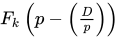
- p2 divides , where is the Legendre symbol;
- Vp(k, −1) ≡ k (mod p2), where Vn(k, −1) is a Lucas sequence of the second kind.

The smallest k-Wall–Sun–Sun primes for k = 2, 3, ... are