Weighted urban proliferation
From Wikipedia, the free encyclopedia

Weighted urban proliferation (WUP) is a method used for measuring urban sprawl. This method, first introduced by Jaeger et al. (2010),[1] calculates and presents the degree of urban sprawl as a numeric value. The method is based on the premise that as the built-over area in a given landscape increases (amount of built-up area), and the more dispersed this built-up area becomes (spatial configuration), and the higher the uptake of this built-up area per inhabitant or job increases (utilization intensity in the built-up area), the higher the overall degree of urban sprawl.[2]
The WUP method, thus, measures urban sprawl by integrating these three dimensions into a single metric.[2]
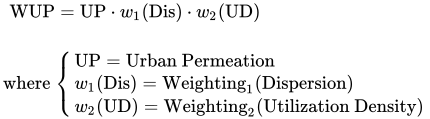
Since the utilization density and dispersion are weighted with the weighting functions and , this metric of urban sprawl is referred to as Weighted Urban Proliferation (WUP).




