Welch bounds
From Wikipedia, the free encyclopedia
In mathematics, Welch bounds are a family of inequalities pertinent to the problem of evenly spreading a set of unit vectors in a vector space. The bounds are important tools in the design and analysis of certain methods in telecommunication engineering, particularly in coding theory. The bounds were originally published in a 1974 paper by L. R. Welch.[1]
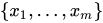
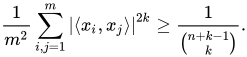
If are unit vectors in , define , where is the usual inner product on . Then the following inequalities hold for : When , this reduces to Welch bounds are also sometimes stated in terms of the averaged squared overlap between the set of vectors. In this case, one has the inequality[2][3][4]

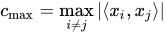


![{\displaystyle (c_{\max })^{2k}\geq {\frac {1}{m-1}}\left[{\frac {m}{\binom {n+k-1}{k}}}-1\right].}](https://wikimedia.org/api/rest_v1/media/math/render/svg/4e455fc8bacf80cdd6c53dbe68fb5fc4630360c2)


Applicability
If , then the vectors can form an orthonormal set in . In this case, and the bounds are vacuous. Consequently, interpretation of the bounds is only meaningful if . This will be assumed throughout the remainder of this article.


Proof for k = 1
The "first Welch bound," corresponding to , is by far the most commonly used in applications. Its proof proceeds in two steps, each of which depends on a more basic mathematical inequality. The first step invokes the Cauchy–Schwarz inequality and begins by considering the Gram matrix of the vectors ; i.e.,


![{\displaystyle G=\left[{\begin{array}{ccc}\langle x_{1},x_{1}\rangle &\cdots &\langle x_{1},x_{m}\rangle \\\vdots &\ddots &\vdots \\\langle x_{m},x_{1}\rangle &\cdots &\langle x_{m},x_{m}\rangle \end{array}}\right]}](https://wikimedia.org/api/rest_v1/media/math/render/svg/2dfcb061e525b007a82031a44b9084ccc9654efd)
The trace of is equal to the sum of its eigenvalues. Because the rank of is at most , and it is a positive semidefinite matrix, has at most positive eigenvalues with its remaining eigenvalues all equal to zero. Writing the non-zero eigenvalues of as with and applying the Cauchy-Schwarz inequality to the inner product of an -vector of ones with a vector whose components are these eigenvalues yields



The square of the Frobenius norm (Hilbert–Schmidt norm) of satisfies
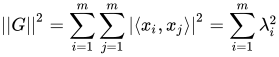
Taking this together with the preceding inequality gives
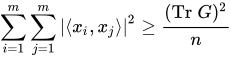
Because each has unit length, the elements on the main diagonal of are ones, and hence its trace is . So,



or
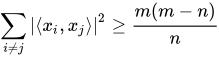
The second part of the proof uses an inequality encompassing the simple observation that the average of a set of non-negative numbers can be no greater than the largest number in the set. In mathematical notation, if for , then


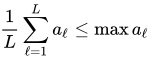
The previous expression has non-negative terms in the sum, the largest of which is . So,



or
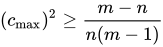
which is precisely the inequality given by Welch in the case that .


