Werner state
From Wikipedia, the free encyclopedia
A Werner state[1] is a × -dimensional bipartite quantum state density matrix that is invariant under all unitary operators of the form . That is, it is a bipartite quantum state that satisfies



for all unitary operators U acting on d-dimensional Hilbert space. These states were first developed by Reinhard F. Werner in 1989.
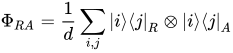
Every Werner state is a mixture of projectors onto the symmetric and antisymmetric subspaces, with the relative weight being the main parameter that defines the state, in addition to the dimension :

![{\displaystyle p\in [0,1]}](https://wikimedia.org/api/rest_v1/media/math/render/svg/33c3a52aa7b2d00227e85c641cca67e85583c43c)


where
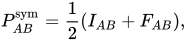
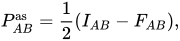
are the projectors and
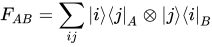
is the permutation or flip operator that exchanges the two subsystems A and B.
Werner states are separable for p ≥ 1⁄2 and entangled for p < 1⁄2. All entangled Werner states violate the PPT separability criterion, but for d ≥ 3 no Werner state violates the weaker reduction criterion. Werner states can be parametrized in different ways. One way of writing them is

where the new parameter α varies between −1 and 1 and relates to p as

Two-qubit example
Two-qubit Werner states, corresponding to above, can be written explicitly in matrix form asEquivalently, these can be written as a convex combination of the totally mixed state with (the projection onto) a Bell state: where (or, confining oneself to positive values, ) is related to by . Then, two-qubit Werner states are separable for and entangled for .



![{\displaystyle \lambda \in [-1/3,1]}](https://wikimedia.org/api/rest_v1/media/math/render/svg/f33ac74e04e451973a8ae1727b37b3bf92379191)
![{\displaystyle \lambda \in [0,1]}](https://wikimedia.org/api/rest_v1/media/math/render/svg/010c0ee88963a09590dd07393d288edd83786b91)




![{\displaystyle p\in \left[0,1\right]}](https://wikimedia.org/api/rest_v1/media/math/render/svg/403c14a696bad2adffdf3b4b91494c89fb043180)



![{\displaystyle {\mathcal {W}}_{A\rightarrow B}^{\text{sym}}(X_{A})={\frac {1}{d+1}}\left[\operatorname {Tr} [X_{A}]I_{B}+\operatorname {id} _{A\rightarrow B}(T_{A}(X_{A}))\right],}](https://wikimedia.org/api/rest_v1/media/math/render/svg/fe6a8ec3313c85a6eb18e6e158efa8f4a206ac84)
![{\displaystyle {\mathcal {W}}_{A\rightarrow B}^{\text{as}}(X_{A})={\frac {1}{d-1}}\left[\operatorname {Tr} [X_{A}]I_{B}-\operatorname {id} _{A\rightarrow B}(T_{A}(X_{A}))\right],}](https://wikimedia.org/api/rest_v1/media/math/render/svg/36bc2b6db13bf41371b1fef8ec6f85108323c9df)