Westerlund 1-20
From Wikipedia, the free encyclopedia
| Observation data Epoch J2000 Equinox J2000 | |
|---|---|
| Constellation | Ara[1] |
| Right ascension | 16h 47m 04.69s[2] |
| Declination | −45° 51′ 23.9″[2] |
| Characteristics | |
| Evolutionary stage | Red supergiant |
| Spectral type | M3[3] - M6I[4] |
| Apparent magnitude (J) | 6.378 |
| Apparent magnitude (H) | 4.381 |
| Apparent magnitude (K) | 2.61 |
| Astrometry | |
| Proper motion (μ) | RA: −2.478[5] mas/yr Dec.: −4.041[5] mas/yr |
| Parallax (π) | 0.1690±0.1073 mas[5] |
| Distance | 2,600+600 −400 (assumed)[6] pc |
| Details | |
| Radius | 858±48[3] R☉ |
| Luminosity | 101,000±13,000[3] L☉ |
| Temperature | 3,284 - 3,550[3] K |
| Other designations | |
| Westerlund 1 W20, Westerlund 1 BKS D, 2MASS J16470468-4551238, Gaia EDR3 5940106007092341120 | |
| Database references | |
| SIMBAD | data |


Westerlund 1-20 (abbreviated to Wd 1-20 or just W20) is a red supergiant (RSG) located in the Westerlund 1 super star cluster. Its radius was calculated to be around 965 solar radii[2] (6.72 × 10⁸ km, 4.48 au), making it one of the largest stars discovered so far. This corresponds to a volume 899 million times bigger than the Sun. If placed at the center of the Solar System, the photosphere of Westerlund 1-20 would almost reach the orbit of Jupiter.

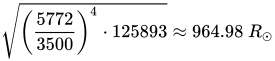
The star is classified as a luminous cool supergiant emitting most of its energy in the infrared spectrum.[7] W20 occupies the upper right corner of the Hertzsprung-Russell diagram. Using the effective temperature of 3,500 K,[2] the bolometric luminosity of 126,000 L☉[2] and the solar effective temperature of 5,772 K,[8] its radius can be calculated using the Stefan-Boltzmann law.[a]
Westerlund 1-20 was observed to have an extended, cometary shaped nebula, similar to the other red supergiant Westerlund 1 W26. It is therefore likely that its morphology was affected by either the intracluster medium or the cluster wind of Westerlund 1.[9] The nebulae of both Westerlund 1-20 and Westerlund 1 W26 are extended outward from the cluster core and most bright at inward direction, indicating the outward cluster wind.[10]