Witten zeta function
From Wikipedia, the free encyclopedia
In mathematics, the Witten zeta function, is a function associated to a root system that encodes the degrees of the irreducible representations of the corresponding Lie group. These zeta functions were introduced by Don Zagier who named them after Edward Witten's study of their special values (among other things).[1][2] Note that in,[2] Witten zeta functions do not appear as explicit objects in their own right.
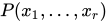
If is a compact semisimple Lie group, the associated Witten zeta function is (the meromorphic continuation of) the series

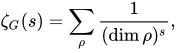
where the sum is over equivalence classes of irreducible representations of .
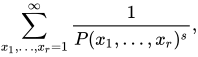
In the case where is connected and simply connected, the correspondence between representations of and of its Lie algebra, together with the Weyl dimension formula, implies that can be written as


where denotes the set of positive roots, is a set of simple roots and is the rank.


Examples
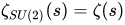
- , the Riemann zeta function.
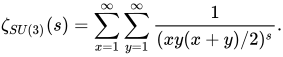





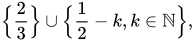


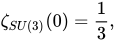


![{\displaystyle \zeta _{SU(3)}(a)={\frac {2^{a+2}}{1+(-1)^{a}2}}\sum _{k=0}^{[a/2]}{2a-2k-1 \choose a-1}\zeta (2k)\zeta (3a-k).}](https://wikimedia.org/api/rest_v1/media/math/render/svg/e7fef6b209353290947ae05f6aa144094502f00e)




