The Womersley number, usually denoted  , is defined by the relation
 where
where  is an appropriate length scale (for example the radius of a pipe),
  is the angular frequency of the oscillations, and
  ,
,  ,
,  are the kinematic viscosity, density, and dynamic viscosity of the fluid, respectively.[2] The Womersley number is normally written in the powerless form
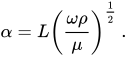
In the cardiovascular system, the pulsation frequency, density, and dynamic viscosity are constant, however the Characteristic length, which in the case of blood flow is the vessel diameter, changes by three orders of magnitudes (OoM) between the aorta and fine capillaries. The Womersley number thus changes due to the variations in vessel size across the vasculature system. The Womersley number of human blood flow can be estimated as follows:
Below is a list of estimated Womersley numbers in different human blood vessels:
| Vessel | Diameter (m) | |
| Aorta | 0.025 | 13.83 |
| Artery | 0.004 | 2.21 |
| Arteriole | 3×10⁻⁵ | 0.0166 |
| Capillary | 8×10⁻⁶ | 4.43×10⁻³ |
| Venule | 2×10⁻⁵ | 0.011 |
| Veins | 0.005 | 2.77 |
| Vena cava | 0.03 | 16.6 |
It can also be written in terms of the dimensionless Reynolds number (Re) and Strouhal number (St):

The Womersley number arises in the solution of the linearized Navier–Stokes equations for oscillatory flow (presumed to be laminar and incompressible) in a tube. It expresses the ratio of the transient or oscillatory inertia force to the shear force. When is small (1 or less), it means the frequency of pulsations is sufficiently low that a parabolic velocity profile has time to develop during each cycle, and the flow will be very nearly in phase with the pressure gradient, and will be given to a good approximation by Poiseuille's law, using the instantaneous pressure gradient. When is large (10 or more), it means the frequency of pulsations is sufficiently large that the velocity profile is relatively flat or plug-like, and the mean flow lags the pressure gradient by about 90 degrees. Along with the Reynolds number, the Womersley number governs dynamic similarity.[3]
The boundary layer thickness  that is associated with the transient acceleration is inversely related to the Womersley number. This can be seen by recognizing the Stokes number as the square root of the Womersley number.[4]
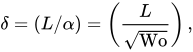 where is a characteristic length.

