Yabroud
City in Rif Dimashq, Syria
From Wikipedia, the free encyclopedia
Yabroud or Yabrud (Arabic: يَبْرُود, romanized: Yabrūd) is a city in Syria, located in the Rif Dimashq (i.e. Damascus' countryside) governorate about 80 kilometres (50 mi) north of the capital Damascus. According to the Syria Central Bureau of Statistics (CBS), Yabroud had a population of 25,891 in the 2004 census.[1]

Yabroud
يبرود Jabrud | |
|---|---|
Streetview | |
  Yabroud Location in Syria | |
| Coordinates: 33°58′N 36°40′E | |
| Country |  Syria Syria |
| Governorate | Rif Dimashq |
| District | Yabroud |
| Subdistrict | Yabroud |
| Elevation | 1,550 m (5,090 ft) |
| Population (2004 census)[1] | |
| 25,891 | |
| • Metro | ~50,000 |
| Area code | 12 |
Jabroudian caves were discovered in the area in 1930. During the Syria Civil War the area was controlled by rebels from 2011 to 2014, before being retaken by government forces.
History
The city is known for its ancient caves, most notably the Iskafta cave (where, in 1930, a thirty-year-old German traveller and self-taught archaeologist Alfred Rust made many important pre-historical findings),[2] which dates back to a period known as Jabroudian culture, named after Yabroud;[3] and the Yabroud temple, which was once Jupiter Yabroudis's temple but later became "Konstantin and Helena Cathedral". Yabroud is home of the oldest church in Syria.[4]
Yabroud was mentioned in the pottery tablets of Mesopotamia in the first century B.C., and Ptolemy's writings in the second century A.D.[5]
In 1838, its inhabitants were Sunni Muslim, Melkite Catholic and Greek Orthodox Christians.[6]
During the Syrian Civil War the city was the center of the Battle of Yabroud in March 2014.[7] The city was held by rebels from 2011 to 2014, before being retaken by Ba'athist Syria and was one of the last places the rebels controlled in the Qalamoun Mountains along the Lebanese border.[8][9]
Notable people
- The parents of Carlos Menem, former President of Argentina, were both born in Yabroud; they emigrated to Argentina before the end of World War I.
- Antun Maqdisi (1914–2005), Syrian philosopher, politician and human rights activist, died in Yabroud.
- Gregory Atta (1815–1899), Syrian archbishop, lived for a time in Yabroud.
- Youssef Halaq (1939–2007), Syrian writer and literary translator.
- George Haswani, Syrian-Russian businessman.
- Saeed Alnahhal, Syrian-Swedish journalist.[10]
- Mariam Faransis, Syrian scholar and writer.
- Jean-Abdo Arbach, B.C., (born 1952), Syrian Melkite Greek Catholic Archeparch of Homs, Hama and Yabroud
Gallery
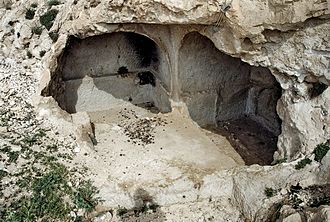 Iskafta cave
 Overview of Yabroud


.svg)