Yasin Valley
Valley in Gilgit-Baltistan
From Wikipedia, the free encyclopedia
Yasin Valley is a high-altitude mountain valley in the Hindu Kush mountain range, located along the Yasin River in the northern region of the Gupis-Yasin District in Gilgit-Baltistan, Pakistan.[1][2][3][4] The valley is situated approximately 148 kilometers (92 miles) from the city of Gilgit, which serves as the capital of Gilgit-Baltistan. Within the valley's territory lies Yasin Tehsil, an administrative subdivision of the region.

Yasin Valley | |
|---|---|
 Yasin River flowing within the valley | |
  Yasin Valley Location in Pakistan | |
| Coordinates: 36°22′15″N 73°20′00″E | |
| Country | Pakistan |
| Administrative unit | Gilgit Baltistan |
| District | Gupis-Yasin District |
| Time zone | UTC+5:00 (PKT) |
History
Despite its sparse population, Yasin Valley has held strategic importance historically. This is due to the fact that it leads to a high mountain pass leading to the Yarkhun Valley and subsequently to the Broghil Pass in Chitral. These passes facilitate connectivity with the Wakhan Corridor in Afghanistan and further to Tajikistan.
Yasin Valley served as the administrative center of Worshigum, which was under the suzerainty of the Khushwaqt dynasty which originated in Chitral. The Mehtars of Yasin were great warriors and fought against the Sikhs and the Dogras of Kashmir under Gohar Aman. In 1863, Dogras invaded Yasin and massacred its people, thus bringing it under their suzerainty. In 1895, the British took control of the territory and made it part of the Gilgit Agency.[5]
People
The primary languages of Yasin Valley are Burushaski language and Khowar Language. English, Wakhi, and Shina are also widely understood.[6]
The majority of the people in Yasin are Isma'ilis, who consider Aga Khan V their spiritual leader. However, people following other branches of both Sunni and Shia Islam also live in Yasin. Ethnically, the people of Yasin are of Burusho origin; however, there are some migrants from different parts of the country.
Havaldar Lalak Jan Shaheed who was given the Pakistan Military's highest award Nishan-e-Haider for his bravery in Kargil War in 1999, belonged to Hundur in Yasin valley.
Geography
Yasin is separated from the Ishkoman Valley by a high mountain pass. To reach Yasin one must take the Karakoram Highway north from Islamabad, and then turn left to reach Gupis in Ghizar on Shandur Road then in few Kilometers from Gupis traverse to the right crossing the China Bridge on Ghizer River, one continues northwest to reach the Yasin Valley.
The part of the valley where Khowar is spoken is known in the Shina language as Arinah.[7]
Passes
The Darkut Pass connects Yasin with Wakhan and Chitral, height 4,570 metres (14,990 ft), Buroghul pass connect Yasin with Brughol, height 3,798 metres (12,461 ft) while the Thoi Pass connects Yasin to Yarkhun Chitral, height 4,499 metres (14,760 ft). Assumber pass connects Yasin to Ishkoman. Darkot Pass is an historical pass which has been labelled as a restricted zone by the government of Pakistan. This pass used to be the shortest means of communication between the Amu Darya and Indus. Most tourism is along the Assumbur Pass to the Ishkoman Valley. one pass is from Darkot yasin to Thoi is called Ghamubar Pass 4,300 m that takes 3 beautiful days. Attar pass height 4,700 metres (15,400 ft) Connects Darkut with Ishkoman Valley and Attar Lake. Three passes (Nazbar, Zagar and Chumarkhan Pass) from Nazbar yasin connect to Mastuj Chitral, height 5,009 metres (16,434 ft), one pass from Bujayote Nala to Bawoshter Ghizat Shamaran, one other pass from Khaimet bar to Chitral.[8]
Yasin Fort

Yasin Fort, located in Yasin Valley, Gilgit-Baltistan, Pakistan, boasts a storied history dating back to the 14th century, when it was constructed by Raja Ganzal, the local ruler, to play a strategic role in controlling the valley and surrounding regions. The fort exemplifies traditional Himalayan architecture, characterized by sturdy stone walls, wooden structures, and intricate carvings. However, in the 19th century, Yasin Fort was plundered by the Ayesho Family under the rule of Aqa Ismail Ali Shah, who brought the entire fortress to the ground, leaving only one tower standing as a warning to traitors who aligned themselves with the Katoor Dynasty of Chitral. The remaining tower bears an inscription: "Do never forget Gohar Aman and his contributions for you Yasinutz." Today, the fort's remnants serve as a testament to its historical significance, and its location in the Ghizer district of Gilgit-Baltistan, Pakistan, makes it a notable historical site in the region.[9]
Gallery

 Sandi Village
 Darkot valley areal view form Attar pass side Yasin

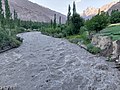 River Yasin cross Barkolti
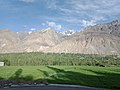 The lands of Yasin


