Youssef Dey Mosque
From Wikipedia, the free encyclopedia
| Youssef Dey Mosque | |
|---|---|
جامع يوسف داي | |
 | |
| Religion | |
| Affiliation | Sunni Islam |
| Status | Active |
| Location | |
| Location | Medina of Tunis, Tunis |
| Country | Tunisia |
 Interactive map of Youssef Dey Mosque | |
| Coordinates | 36°47′49″N 10°10′10″E / 36.79694°N 10.16944°E |
| Architecture | |
| Architect | Ibn Ghaleb al-Andalusi |
| Type | Mosque |
| Style | Ottoman |
| Founder | Yusuf Dey |
| Established | 1612 |
| Specifications | |
| Dome | 1 |
| Minaret | 1 |
| Minaret height | 25 m (85 ft) |
Youssef Dey Mosque, also known as Al B'chamqiya, is a 17th-century mosque in Tunis, Tunisia, located in Medina area of the city. The mosque is considered significant as it was the first Ottoman mosque to be built in Tunis.[1]
An official Historical Monument, it operated primarily as public speaking venue before becoming a real mosque by Youssef Dey in 1631. At the time it was the 11th mosque to be built in the capital. In the late nineteenth century it underwent extensive restoration, ordered by Ali Bey. A decree in 1926 saw the mosque become an annex of the University of Ez-Zitouna.[2]
 Minaret
 Beginning of the 20th century
 Youssef Dey Mosque in 1908
 External view
 Internal view
 Mosque courtyard


The prayer room is framed by courtyards on three sides to the east, north and west. Along the northern facade, a portico plays the role of gallery-narthex. Rectangular in plan, the room perpetuates the classical plan of the hypostyle hall; it consists of nine naves and seven bays. The arches rest on columns, of various origins, which carry capitals of Hafsid type, except some ancient examples. The covering of the prayer hall is in groin vault; a cupola on an octagonal base and horns in front of the mihrab.[3] Near the latter is the masonry minbar covered with panels of polychrome marble; this is a novelty by contribution to mosques of Malikis whose minbar is executed in wood.[3]
 Detail of one of the doors of the mosque.
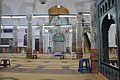 Interior view of the prayer hall. At the bottom is the mihrab.
.jpg)

.jpg)
.jpg)
.jpg)


