Yugoslavs in Serbia
From Wikipedia, the free encyclopedia
Југословени у Србији Jugosloveni u Srbiji | |
|---|---|
| Total population | |
| 27,143 (2022)[1] | |
| Regions with significant populations | |
 Vojvodina Vojvodina | 12,438[2] |
 Belgrade Belgrade | 10,499[2] |
| Languages | |
| Serbo-Croatian | |
| Religion | |
| Predominately irreligious; Eastern Orthodoxy, Catholicism, Islam | |
| Part of a series on |
| Yugoslavs |
|---|
 |
| By region |
| Culture |
| History |
| Languages |
| People |
|
| Ethnicities |
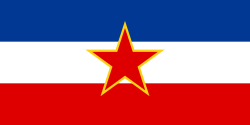
Yugoslavs in Serbia refers to a community in Serbia that view themselves as Yugoslavs with no other ethnic self-identification. According to data from the 2022 census, 27,143 people or 0.4% of population of Serbia declared their ethnicity as exclusively Yugoslav.[1]
Besides self-declared Yugoslavs, there are also Serbs, Croats, Montenegrins, Bosniaks, and people of other ethnicities in Serbia who identify themselves as Yugoslavs in a broader sense. However, they don't consider themselves to be part of a Yugoslav ethnicity, which is the way the self-declared Yugoslavs identify themselves.
Ahead of the 2022 census, a newly formed organization called National Movement "Yugoslavs" (Narodni pokret “Jugosloveni”)[3] began campaigning to citizens of Serbia to freely self-identify as Yugoslavs, an initiative joined by a number of public figures. One of them is a radio host Daško Milinović, who also announced that work is underway for establishing the National Council of Yugoslavs in Serbia for self-identifying Yugoslavs to enjoy equal ethnic minority rights.[4][5] According to Milinović, Yugoslavs are a community not in an ethnic sense but a community of common values.[5] Among the younger generations who never lived in former Yugoslavia, identifying as Yugoslav tends to be due to their multi-ethnic background but also in protest against nationalism.[6]
Demographics
People declaring themselves as Yugoslavs are largely concentrated in Vojvodina and Belgrade, where around 85% of all Yugoslavs in Serbia are found.
| Year | Population | Share |
|---|---|---|
| 1971[7] | 123,824 | 1.4% |
| 1981[8] | 441,941 | 4.7% |
| 1991[9][10] | 323,643 | 3.3% |
| 1991[11][12] | 320,186 | 4.1% |
| 2002 (excl. Kosovo)[13] | 80,721 | 1.1% |
| 2011 (excl. Kosovo)[14] | 23,303 | 0.3% |
| 2022 (excl. Kosovo)[1] | 27,143 | 0.4% |
| Region | Population | Share |
|---|---|---|
| Vojvodina | 12,438 | 0.7% |
| Belgrade | 10,499 | 0.6% |
| Šumadija and Western Serbia | 2,327 | 0.1% |
| Southern and Eastern Serbia | 1,879 | 0.1% |