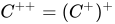
双極定理 From Wikipedia, the free encyclopedia 数学において、双極定理(そうきょくていり、英: bipolar theorem)とは、錐がその双極と等しいための必要十分条件を与える凸解析の一定理である。双極定理は、フェンシェル=モローの定理の特別な場合と見なすことが出来る[1]:76–77。 特別な場合 ある線型空間 X {\displaystyle X} 内の任意の空でない集合 C ⊂ X {\displaystyle C\subset X} に対し、双極錐 C o o = ( C o ) o {\displaystyle C^{oo}=(C^{o})^{o}} は次で与えられる。 C o o = cl ( co { λ c : λ ≥ 0 , c ∈ C } ) {\displaystyle C^{oo}=\operatorname {cl} (\operatorname {co} \{\lambda c:\lambda \geq 0,c\in C\})} ここで co {\displaystyle \operatorname {co} } は凸包を表す[1]:54[2]。 C ⊂ X {\displaystyle C\subset X} が空でない閉凸錐であるための必要十分条件は、 C + + = ( C + ) + {\displaystyle C^{++}=(C^{+})^{+}} であるときに C + + = C o o = C {\displaystyle C^{++}=C^{oo}=C} であることである。ここで ( ⋅ ) + {\displaystyle (\cdot )^{+}} は正の双対錐を表す[2][3]。 あるいはより一般に、 C {\displaystyle C} が凸錐であるなら双極錐は次で与えられる。 C o o = cl C . {\displaystyle C^{oo}=\operatorname {cl} C.} フェンシェル=モローの定理との関係 f ( x ) = δ ( x | C ) = { 0 if x ∈ C + ∞ else {\displaystyle f(x)=\delta (x|C)={\begin{cases}0&{\text{if }}x\in C\\+\infty &{\text{else}}\end{cases}}} はある錐 C {\displaystyle C} に対する指示函数とする。このとき、凸共役 f ∗ ( x ∗ ) = δ ( x ∗ | C o ) = δ ∗ ( x ∗ | C ) = sup x ∈ C ⟨ x ∗ , x ⟩ {\displaystyle f^{*}(x^{*})=\delta (x^{*}|C^{o})=\delta ^{*}(x^{*}|C)=\sup _{x\in C}\langle x^{*},x\rangle } は C {\displaystyle C} に対する支持函数(英語版)であり、 f ∗ ∗ ( x ) = δ ( x | C o o ) {\displaystyle f^{**}(x)=\delta (x|C^{oo})} である。したがって、 C = C o o {\displaystyle C=C^{oo}} であるための必要十分条件は、 f = f ∗ ∗ {\displaystyle f=f^{**}} である[1]:54[3]。 参考文献 1 2 3 Borwein, Jonathan; Lewis, Adrian (2006). Convex Analysis and Nonlinear Optimization: Theory and Examples (2 ed.). Springer. ISBN 9780387295701 1 2 Boyd, Stephen P.; Vandenberghe, Lieven (2004) (pdf). Convex Optimization. Cambridge University Press. pp. 51–53. ISBN 9780521833783. http://www.stanford.edu/~boyd/cvxbook/bv_cvxbook.pdf 2011年10月15日閲覧。 1 2 Rockafellar, R. Tyrrell (1997) [1970]. Convex Analysis. Princeton, NJ: Princeton University Press. pp. 121–125. ISBN 9780691015866 Related Articles~TimelinesTop QsFact Checks