花綱
From Wikipedia, the free encyclopedia

花綱の起源は、祭りの日に玄関の上に飾られたり、祭壇の周りに吊るされたりした自然の花などの花輪を石で表現したことによると推定される[3]。
このデザインは古代ギリシャとローマで広く採用され、祭壇、フリーズ、パネルの主要な装飾となった[3]。リボンの両端をリボン状にしたり、ねじった曲線にしたりすることもある。更に葉や花を吊り下げる場合は、ドロップ(drop)またはマージェント(margent)と呼ばれる[1]。
このモチーフはその後、新古典主義建築や装飾美術、特に陶磁器や銀細工の作品に用いられた。例えば、リボンは、装飾された結び目から吊り下げられたり、獅子の口にくわえられたり、ティヴォリのヴェスタ神殿のようにブクラニアの上部に吊り下げられたりする。
画像
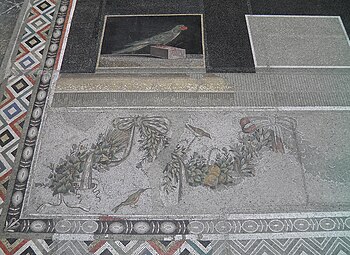 Detail of an Ancient Greek mosaic floor, Pergamon Museum, Berlin, Germany, unknown architect, 2nd century BC
 Roman trompe-l'œil wall painting from a villa, with festoons and bucrania, c.50-40 BC, fresco, Metropolitan Museum of Art, New York
 Highly decorated Roman sarcophagus with festoons, c.125-130 AD, marble, Louvre
 Roman festoon, c.70 BC, mosaic, Casa di Nettuno e Anfitrite, Herculaneum Archaeological Park, Ercolano, Italy[4]
 Festoons on Roman cremation urns, 2nd century AD, marble, Musée d'archéologie méditerranéenne, Marseille, France
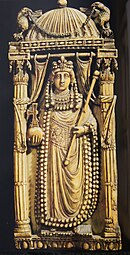 Byzantine festoon at the top of a relief of Empress Ariadne, c.500, ivory, National Bargello Museum, Florence, Italy[5]
 Festoon, masks and rosettes made of shells, by Jan van Kessel the Elder, 17th century, color on copper, Fondation Custodia, Paris
 Garland of Flowers around an Allegory of Farming, by Jan Brueghel the Elder and Hendrick van Balen the Elder, 1615, oil on panel, Mauritshuis, The Hague, the Netherlands
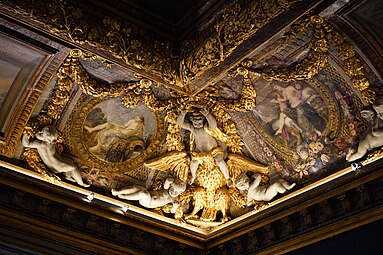 Baroque festoons on the boiserie of a room from the Hôtel Colbert de Villacerf, now in the Musée Carnavalet, Paris, unknown architect, sculptor and painter, c.1650[6]
 Baroque festoon with a mascaron in the Hall of Mirrors of the Palace of Versailles, Versailles, France, designed by Jules Hardouin-Mansart, 1678-1684[7]
 Rococo or Louis XVI style festoon ornament, 18th century, gilt bronze, Metropolitan Museum of Art
 Louis XVI style Cupid seated on a festoon made of flowers, c.1770-1790, oil on canvas, Metropolitan Museum of Art
 Louis XVI style festoons on the Table de Teschen, by Johann Christian Neuber, 1775-1800, gilt bronze, semiprecious stones, porcelain, and wood, Louvre[8]
 Louis XVI style vase decorated with festoons, design attributed to Jean-Claude Chambellan Duplessis, by the Sèvres porcelain factory, 1780, painted and gilded hard-paste porcelain, gilt bronze, Rijksmuseum Amsterdam, the Netherlands
 Neoclassical festoons on a bed, by Thomas Chippendale, 1773, carved and gilt wood, Harewood House, Harewood, West Yorkshire, England
 Louis XVI flower festoons on a tapestry showing Don Quixote guided by folly, by the Gobelins Manufactory, 1780-1783, wool and silk, woven on a low-warp loom, Philadelphia Museum of Art, US
 Louis XVI style festoons on a ceiling in the State Dining Room, Inveraray Castle, Scotland, the UK, by Girard and Guinand, 1784[9]
 Neoclassical festoon on a vase, by the Sèvres Porcelain Factory, 1814, hard-paste porcelain with platinum background and gilt bronze mounts, Louvre[10]
 Neoclassical festoon in the Grave of Louis Gabriel Suchet, Père-Lachaise Cemetery, Paris, designed by Louis Visconti, sculpted by Pierre-Jean David and Jean-Baptiste-Louis Plantar, 1826
 Neoclassical festoons with Egyptian Revival elements around them, on the ceiling of room 644 of the Louvre Palace, unknown painter, c.1840
 Neoclassical festoon on the ceiling of room 643 of the Louvre Palace, unknown painter, c.1840
 Neoclassical festoon on the ceiling of room 642 of the Louvre Palace, unknown painter, c.1840
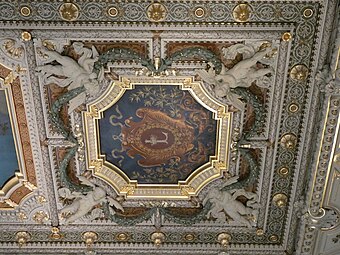 Neoclassical festoons on a ceiling of the Palais de la Bourse, Lyon, France, designed by Alexandre-Dominique Denuelle and sculpted by Guillaume Bonnet, 1855-1862
 Neoclassical festoon on the facade of the Palais Garnier, Paris, designed by Charles Garnier, 1860–1875[11]
 Neoclassical festoon on the Grave of the Pillet family, Loyasse Cemetery, Lyon, designed by Jean-Prosper Bissuel and sculpted by Pierre-Toussaint Bonnaire, probably 1869
 Neoclassical relief with putti and festoons on the Dimitrie Sturdza House (Strada Arthur Verona no. 13-15), Bucharest, Romania, 1883, unknown architect[12]
 Festoon on a vase of Anthony van Dyck painting his first painting, by Dalou Aimé-Jules and the Sèvres Porcelain Factory, c.1888, sandstone, Petit Palais
 Beaux Arts festoons on an architectural element of the Palais des Beaux-Arts, part of the 1889 Paris Exposition, now in the Square Paul-Langevin, Paris, by Jules-Paul Loebnitz, 1889
 Beaux Arts oak leaf festoons on the Jean Leclaire Monument, Square des Épinettes, Paris, by Jean Camille Formigé, 1896
 Beaux Arts festoons of the Pont Alexandre III, Paris, designed by Joseph Cassien-Bernard and Gaston Cousin, 1896-1900
 Stylized Art Nouveau festoon on a ceiling of Calea Dorobanților no. 50A, Bucharest, unknown architect, c.1900
 Greek Revival festoons in the Villa Kerylos, Beaulieu-sur-Mer, France, designed by Emmanuel Pontremoli, 1902-1908
 Beaux Arts mascaron with festoons on Rue de la Paix no. 23, Paris, unknown architect, 1908
 Beaux Arts festoons above the door of Avenue Kléber no. 47bis, Paris, unknown architect, 1908[13]
 Beaux Arts gate with festoons of Strada Vasile Conta no. 14, Bucharest, unknown architect, c.1910
 Neo-Louis XVI style festoons with a medallion above a door in Strada Arthur Verona no. 15, Bucharest, unknown architect, c.1910
 Beaux Arts swags of a cartouche on the Nicolae T. Filitti/Nae Filitis House (Calea Dorobanților no. 18), by Ernest Doneaud, c.1910[14]
 Art Nouveau festoons on the walls and columns of a room in the Casa Comalat, Barcelona, Spain, by Salvador Valeri i Pupurull, 1911[15]
 Rococo Revival festoon on a stained-glass window in the orangery of the Ecaterina Procopie House (Strada Bocșa no. 4), Bucharest, unknown architect or painter, c.1912[16]
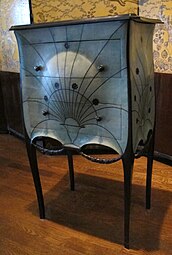 Art Deco festoons on a commode, by Paul Iribarne Garay, c.1912, mahogany and tulip wood frame, slate top, green-tinted shagreen upholstery, ebony knobs, base and garlands, Museum of Decorative Arts, Paris
 Art Deco festoons in the pediment of the Mihai Zisman House (Calea Călărașilor no. 44), Bucharest, by architect Soru, 1920
 Highly stylized Art Deco festoons on the Grave of the Vetter Family, Cemetery of Croix-Rousse (new), Rhône, France, designed by Michel Roux-Spitz, and sculpted by Marcel Renard and Raymond Delamarre, c.1920
.jpg)


.jpg)


.jpg)


.jpg)
_top.jpg)
,_design_attributed_to_Jean_Claude_Duplessis,_Rijksmuseum,_Amsterdam,_the_Netherlands.jpg)


.jpg)

.jpg)
.jpg)
.jpg)
.jpeg)


.jpg)


.jpg)

.jpg)
.jpg)
.jpg)
.jpg)
.jpg)

.jpg)

.jpg)
.jpg)


