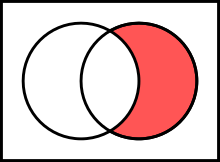
逆非含意 From Wikipedia, the free encyclopedia P ↚ {\displaystyle \nleftarrow } Q のベン図による表現。Pは左に、Qは右に配置されている。 逆非含意(ぎゃくひがんい)は、逆含意の否定、つまり第1命題が偽で第2命題が真のときのみ真となる論理演算である。 逆非含意は P ↚ Q {\displaystyle P\nleftarrow Q} のような形式で表記され、「p でないのに q である」といったように読む。 真理値表 古典論理においては、否定 ¬ と論理積 ∧ で表せる。 ( P ↚ Q ) ⇔ ¬ ( P ← Q ) ⇔ ( ¬ P ∧ Q ) {\displaystyle (P\nleftarrow Q)\Leftrightarrow \lnot (P\leftarrow Q)\Leftrightarrow (\lnot P\land Q)} P ↚ Q {\displaystyle P\nleftarrow Q} の真理値表は以下。 命題 P命題 QP ↚ {\displaystyle \nleftarrow } Q 真真偽 真偽偽 偽真真 偽偽偽 関連項目 逆含意 非含意 真理値 真理値表 ベン図 この項目は、自然科学に関連した書きかけの項目です。この項目を加筆・訂正などしてくださる協力者を求めています(Portal:自然科学)。表示編集 表話編歴論理演算 恒真式 ( ⊤ {\displaystyle \top } ) NAND ( ↑ {\displaystyle \uparrow } ) 逆含意 ( ← {\displaystyle \leftarrow } ) IMP ( → {\displaystyle \rightarrow } ) OR ( ∨ {\displaystyle \lor } ) 否定 ( ¬ {\displaystyle \neg } ) XOR ( ⊕ {\displaystyle \oplus } ) 同値 ( ↔ {\displaystyle \leftrightarrow } ) 命題 NOR ( ↓ {\displaystyle \downarrow } ) 非含意 ( ↛ {\displaystyle \nrightarrow } ) 逆非含意 ( ↚ {\displaystyle \nleftarrow } ) AND ( ∧ {\displaystyle \land } ) 矛盾 ( ⊥ {\displaystyle \bot } ) Related Articles~TimelinesTop QsFact Checks
 P
P  Q のベン図による表現。Pは左に、Qは右に配置されている。
 のような形式で表記され、「p でないのに q である」といったように読む。


