119 series
Japanese DC electric multiple unit train type
From Wikipedia, the free encyclopedia
The 119 series (119ç³») was a DC electric multiple unit (EMU) train type which was operated on local services in Japan by Japanese National Railways (JNR) and later by Central Japan Railway Company (JR Central) between 1983 and March 2012.[1]

| 119 series | |
|---|---|
A 119-5300 series 2-car set in March 2008 | |
| In service | 1983âMarch 2012 |
| Manufacturer | Nippon Sharyo |
| Constructed | 1982â1983 |
| Number built | 57 vehicles |
| Number in service | None |
| Successor | 313 series |
| Formation | 1/2 cars per trainset |
| Operators | JNR (1983â1987) JR Central (1987â2012) |
| Depot | Ågaki |
| Line served | Iida Line |
| Specifications | |
| Car body construction | Steel |
| Car length | 20,000 mm (65 ft 7 in) |
| Width | 2,832 mm (9 ft 3.5 in) |
| Height | 3,935 mm (12 ft 10.9 in) |
| Doors | 3 pairs per side |
| Maximum speed | 100 km/h (60 mph) |
| Traction system | Resistor control |
| Power output | 440 kW per motor car |
| Acceleration | 2.8 km/h/s (single-car units) 1.6 km/h/s (2-car units) |
| Electric system | 1,500 V DC |
| Current collection | Overhead catenary |
| Braking systems | Dynamic brake, electro-pneumatic brake |
| Safety system | ATS-ST |
| Track gauge | 1,067 mm (3 ft 6 in) |
Design
The 119 series design was based on the earlier 105 series EMU type, with improvements to cope with the steep gradients and winter climate of the Iida Line.[1]
Variants
- 119â0 series (Eight two-car sets, E10â17)
- 119â100 series (single-car sets converted by adding a second driving cab)
- 119â5000 series (Nine two-car sets, E1â9, converted by adding inverter air-conditioning)
- 119â5100 series (Nine single-car sets, M1â9, converted from 119â100 series sets by adding inverter air-conditioning)
- 119â5300 series (Eight two-car sets, R1â8, converted from 119â5000 series sets for wanman driver-only operation)
Formations
The sets were formed as follows.[2]
119-0 series 2-car sets E10â17
| Designation | Mc | Tc' |
|---|---|---|
| Numbering | KuMoHa 119 | KuHa 118 |
The KuMoHa 119 car was fitted with one lozenge-type pantograph.
 119-0 series set E17 in May 2011

119-100 series single-car sets M1â9
| Designation | cMc |
|---|---|
| Numbering | KuMoHa 119â100 |
Each car was fitted with one lozenge-type pantograph.
 119-100 series set M2 in original blue livery (date unknown)

119-5000 series 2-car sets E1â9
| Designation | Mc | Tc' |
|---|---|---|
| Numbering | KuMoHa 119â5000 | KuHa 118â5000 |
The KuMoHa 119 car was fitted with one lozenge-type pantograph.
 119-5000 series set E8 in February 2011

119-5100 series single-car sets M1â9
| Designation | cMc |
|---|---|
| Numbering | KuMoHa 119â5100 |
Each car was fitted with one lozenge-type pantograph.
 119-5100 series set M6 in February 2012

119-5300 series 2-car sets R1â8
| Designation | Mc | Tc' |
|---|---|---|
| Numbering | KuMoHa 119â5300 | KuHa 118â5300 |
The KuMoHa 119 car was fitted with one lozenge-type pantograph.
 119-5300 series set R5 in June 2011

Interior


Livery variations
Set E4 was repainted into its original JNR era livery in August 2009.[2]
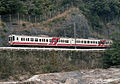 A 119 series set in "Suruga Shuttle" livery, circa 1990
 119-5000 series set E4 in February 2012, repainted into original JNR-era livery


History

From 18 March 1983, all Iida Line services were made no-smoking.[2]
From 3 March 2001, Iida Line services were switched to wanman driver-only operation.[2]
The fleet was replaced by 213-5000 and 313-3000 series EMUs on the Iida Line, with the last train running on 31 March 2012.[3]
Resale
Following withdrawal, six 2-car 119 series sets were sold to the third sector railway operator Echizen Railway in Fukui Prefecture, where they were converted to become Echizen Railway 7000 series EMUs, entering service from February 2013.[4]
 Echizen Railway 7000 series, February 2013

