2012 VP113
Sednoid
From Wikipedia, the free encyclopedia
2012 VP113 is a trans-Neptunian object (TNO) orbiting the Sun on an extremely distant and markedly elliptical orbit. It is classified as a sednoid because its orbit never comes closer than 80.5 AU (12.04 billion km; 7.48 billion mi) from the Sun, which is far enough away from the giant planets that their gravitational influence cannot affect the object's orbit noticeably. It was discovered on 5 November 2012 at Cerro Tololo Inter-American Observatory in Chile, by American astronomers Scott Sheppard and Chad Trujillo, who nicknamed the object "Biden" after the "VP" in its designation.[8] The discovery was announced on 26 March 2014.[6][8] The object's size has not been measured, but its brightness suggests that it is around 450 km (280 mi) in diameter.[6][9] 2012 VP113 has a reddish color similar to many other TNOs.[6]

2012 VP113 imaged by the Canada–France–Hawaii Telescope on 9 October 2021 | |
| Discovery[1] | |
|---|---|
| Discovered by | |
| Discovery site | Cerro Tololo Obs. |
| Discovery date | 5 November 2012 |
| Designations | |
| "Biden" (nickname) | |
| Orbital characteristics (barycentric)[4] | |
| Epoch 5 May 2025 (JD 2460800.5) | |
| Uncertainty parameter 3[2] | |
| Observation arc | 16.94 yr (6,187 d) |
| Earliest precovery date | 19 September 2007 |
| Aphelion | 444.1 AU |
| Perihelion | 80.52 AU |
| 262.3 AU | |
| Eccentricity | 0.6931 |
| 4,246 yr[4] | |
| 24.05° | |
| 0° 0m 0.836s / day | |
| Inclination | 24.0563°±0.006° |
| 90.80° | |
| ≈ September 1979[5] | |
| 293.90° | |
| Known satellites | 0 |
| Physical characteristics | |
| 450 km (for an assumed albedo of 0.15)[6] | |
| |
| 23.5[7] | |
| 4.05[2] | |
2012 VP113 has not yet been imaged by high-resolution telescopes, so it has no known moons.[10] The Hubble Space Telescope is planned to image 2012 VP113 in 2026, which should determine if it has significantly sized moons.[10]
History
Discovery

2012 VP113 was first reported to have been observed on 5 November 2012[1] with NOAO's 4-meter Víctor M. Blanco Telescope at the Cerro Tololo Inter-American Observatory.[11] Carnegie's 6.5-meter Magellan telescope at Las Campanas Observatory in Chile was used to determine its orbit and surface properties.[11]
Before being announced to the public, 2012 VP113 was only tracked by Cerro Tololo Inter-American Observatory (807) and Las Campanas Observatory (304).[12]
2012 VP113 has been found in precovery images as early as September 2007.[12]
Nickname
2012 VP113 was abbreviated "VP" and nicknamed "Biden" by the discovery team, after Joe Biden who was then the vice president ("VP") of the United States.[8]
Physical characteristics
2012 VP113 has an absolute magnitude of 4.05,[2][12] which means it may be large enough to be a dwarf planet.[13] The diameter and geometric albedo of 2012 VP113 has not been measured yet.[6][9] Under the assumption that 2012 VP113 has a moderate geometric albedo of 0.15 (typical of TNOs), its diameter would be around 450 km (280 mi).[6] A wider range of albedos gives a possible diameter range of 300–1,000 km (190–620 mi).[9] It is expected to be about half the size of Sedna and similar in size to Huya.[9] Its surface is moderately red in color, resulting from chemical changes produced by the effect of radiation on frozen water, methane, and carbon dioxide.[14] This optical color is consistent with formation in the gas-giant region and not the classical Kuiper belt, which is dominated by ultra-red colored objects.[6]
Orbit and classification

2012 VP113 has the farthest perihelion (closest approach to the Sun) of all known minor planets and all known objects in the Solar System as of 2025[update], greater than Sedna's.[15] Though its perihelion is farther, 2012 VP113 has an aphelion only about half of Sedna's. It is the second discovered sednoid, with a semi-major axis beyond 150 AU and a perihelion greater than 50 AU. The similarity of the orbit of 2012 VP113 to other known extreme trans-Neptunian objects led Scott Sheppard and Chad Trujillo to suggest that an undiscovered object, Planet Nine, in the outer Solar System is shepherding these distant objects into similar type orbits.[6]
Its last perihelion was within a couple months of September 1979.[5] The paucity of bodies with perihelia at 50–75 AU appears not to be an observational artifact and is known as the Kuiper cliff.[6]
2012 VP113 is possibly a member of a hypothesized Hills cloud.[9][11][16] It has a perihelion, argument of perihelion, and current position in the sky similar to those of Sedna.[9] In fact, all known Solar System bodies with semi-major axes over 150 AU and perihelia greater than Neptune's have arguments of perihelion clustered near 340°±55°.[6] This could indicate a similar formation mechanism for these bodies.[6] (148209) 2000 CR105 was the first such object to be discovered.
It is currently unknown how 2012 VP113 acquired a perihelion distance beyond the Kuiper belt. The characteristics of its orbit, like those of Sedna's, have been explained as possibly created by a passing star or a trans-Neptunian planet of several Earth masses hundreds of astronomical units from the Sun.[17] The orbital architecture of the trans-Plutonian region may signal the presence of more than one planet.[18][19] 2012 VP113 could even be captured from another planetary system.[13] However, it is considered more likely that the perihelion of 2012 VP113 was raised by multiple interactions within the crowded confines of the open star cluster in which the Sun formed.[9]
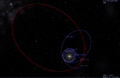 Simulated view showing the orbit of 2012 VP113
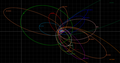 2012 VP113 orbit in white with hypothetical Planet Nine
 The orbits of known distant objects with large aphelion distances over 200 AU


See also
- List of Solar System objects most distant from the Sun
- 90377 Sedna – first sednoid discovered
- 541132 Leleākūhonua – third sednoid discovered
- List of hyperbolic comets
- List of possible dwarf planets
- Other large aphelion objects
- (668643) 2012 DR30 (15–2880 AU)
- 2005 VX3 (4–1630 AU)
- (709487) 2013 BL76 (8–1870 AU)
- 2014 FE72 (36–2680 AU)

