2012 in archosaur paleontology
From Wikipedia, the free encyclopedia
| List of years in archosaur paleontology |
|---|


The year 2012 in archosaur paleontology was eventful. Archosaurs include the only living dinosaur group — birds — and the reptile crocodilians, plus all extinct dinosaurs, extinct crocodilian relatives, and pterosaurs. Archosaur palaeontology is the scientific study of those animals, especially as they existed before the Holocene Epoch began about 11,700 years ago. The year 2012 in paleontology included various significant developments regarding archosaurs.
This article records new taxa of fossil archosaurs of every kind that have been described during the year 2012, as well as other significant discoveries and events related to paleontology of archosaurs that occurred in the year 2012.
Research
- The postcranial skeleton of Sebecus icaeorhinus is described by Diego Pol et al. (2012).[1]
- Skull anatomy of Dakosaurus and Plesiosuchus is described by Mark T. Young et al. (2012).[2]
- Kemkemia auditorei, previously thought to be a theropod dinosaur, is reinterpreted as a member of Crocodyliformes by Gabriel Lio et al. (2012).[3]
- A study including a supertree of Crocodyliformes is published by Mario Bronzati, Felipe Chinaglia Montefeltro and Max C. Langer (2012).[4]
- Skull remains of a member of the genus Gavialis belonging or related to the species Gavialis bengawanicus are described from the Early Pleistocene of Thailand by Martin et al. (2012).[5]
New taxa
| Name | Novelty | Status | Authors | Age | Unit | Location | Notes | Images |
|---|---|---|---|---|---|---|---|---|
|
Gen. et sp. nov |
Valid |
Holliday & Gardner |
Cenomanian |
| ||||
|
Gen. et sp. nov |
Valid |
Desojo, Ezcurra & Kischlat |
Late Carnian or early Norian |
An aetosaur. |
||||
|
Gen. et sp. nov |
Valid |
Spielmann & Lucas |
Late Triassic |
An aetosaur. The type species is Apachesuchus heckerti. |
||||
|
Gen. et sp. nov |
Valid |
Iori & Garcia |
A itasuchid. The type species is Barreirosuchus franciscoi. |
 | ||||
|
Sp. nov |
Valid |
Brochu, Parris, Grandstaff, Denton & Gallagher |
Maastrichtian or Danian |
A crocodilian from New Jersey. |
||||
|
Gen. et sp. nov |
Valid |
Sennikov |
Early Triassic |
A ctenosauriscid. The type species is Bystrowisuchus flerovi. |
||||
|
sp nov |
Valid |
Brochu & Storrs |
Pliocene to Pleistocene |
A species of Crocodylus. |
| |||
|
Gen. et sp. nov |
Valid |
Martinelli et al. |
Late Cretaceous |
A peirosaurid. The type species is Gasparinisuchus peirosauroides. |
||||


Newly named basal dinosauriforms
| Name | Novelty | Status | Authors | Age | Unit | Location | Notes | Images |
|---|---|---|---|---|---|---|---|---|
|
Gen. et sp. nov |
Valid |
Kammerer, Nesbitt, & Shubin |
?Carnian-Norian |
A silesaurid. |
 | |||
Non-avian dinosaurs
Research
- A study including a large phylogenetic analysis of non-coelurosaurian tetanuran theropod dinosaurs is published by Matthew T. Carrano, Roger B. J. Benson and Scott D. Sampson (2012).[15]
- A study including a systematic revision of the family Dromaeosauridae and a large phylogenetic analysis of paravian theropod dinosaurs (both avian and non-avian) is published by Alan Turner, Peter Makovicky and Mark Norell (2012).[16]
- A specimen of Microraptor is described by Quanguo Li et al. (2012), with melanosome imprints making it possible to determine the plumage coloration and iridescence in the plumage.[17]
- A new specimen of Austroraptor cabazai is described by Philip J. Currie and Ariana Paulina Carabajal (2012).[18]
- A specimen of Mei long is described by Chunling Gao et al. (2012).[19]
- A study of Khaan mckennai was published by Amy M. Balanoff and Mark Norell (2012).[20]
- A new information on Yixianosaurus longimanus is published by T. Alexander Dececchi, Hans C. E. Larsson and David W. E. Hone (2012).[21]
- Three specimens of Ornithomimus with evidence of feathers are described by Darla K. Zelenitsky et al. (2012).[22]
- A new information on the anatomy of the holotype specimen of Nqwebasaurus thwazi is published by Jonah N. Choiniere, Catherine A. Forster and William J. de Klerk (2012).[23]
- A study of Alioramus was published by Stephen Brusatte, Thomas D. Carr and Mark Norell (2012).[24]
- Abdominal contents of two specimens of Sinocalliopteryx gigas are described by Lida Xing et al. (2012).[25]
- A study of musculoskeletal anatomy, three-dimensional body proportions and body mass evolution in allosauroid theropod dinosaurs is published by Karl T. Bates, Roger B. J. Benson, and Peter L. Falkingham (2012).[26]
- A study of the braincase of Sinraptor dongi is published by Ariana Paulina Carabajal and Philip J. Currie (2012).[27]
- A study of Kelmayisaurus petrolicus, interpreting it as likely to be a member of Carcharodontosauridae, is published by Stephen L. Brusatte, Roger B.J. Benson and Xing Xu (2012).[28]
- Description of pectoral girdle and forelimb of Majungasaurus crenatissimus is published by Sara H. Burch and Matthew T. Carrano (2012).[29]
- A study of Early Cretaceous Australian theropod dinosaurs was published by Roger B. J. Benson et al. (2012).[30]
- A study including a phylogenetic analysis of titanosauriform sauropod dinosaurs is published by Michael D'Emic (2012).[31]
- The postcranial skeletal pneumaticity in the skeletons of five taxa of early sauropodomorph dinosaurs is described by Adam M. Yates, Mathew J. Wedel and Matthew F. Bonnan (2012).[32]
- The study on the presumed course of the recurrent laryngeal nerve in sauropod dinosaurs is published by Mathew J. Wedel (2012).[33]
- Pachysuchus, previously thought to be an Early Jurassic phytosaur, is reinterpreted as a sauropodomorph dinosaur by Paul M. Barrett and Xu Xing (2012).[34]
- A study of vertebral laminae of sauropod dinosaurs is published by Jeffrey A. Wilson (2012).[35]
- A study on the neural spine bifurcation in diplodocoid sauropod dinosaurs is published by D. Cary Woodruff and Denver W. Fowler (2012).[36]
- A study of the postcranial skeletal pneumaticity in the skeletons of Saltasaurus, Neuquensaurus and Rocasaurus is published by Ignacio A. Cerda, Leonardo Salgado and Jaime E. Powell (2012).[37]
- A study of Early Cretaceous sauropod dinosaurs from North America is published by Michael D. D’Emic and Brady Z. Foreman (2012). Among other findings, additional sauropod material from the Cloverly Formation of Wyoming was referred to Sauroposeidon, Paluxysaurus was synonymized with Sauroposeidon, Rugocaudia was considered a nomen dubium and the cause of the North American sauropod extinction in the middle of the Cretaceous period was discussed.[38]
- The first sauropod dinosaur (a member of Titanosauria) from Antarctica described by Ignacio A. Cerda et al. (2012).[39]
- A study of biomechanics, pectoral girdle articulation and body mass of the Triassic dinosaurs from Brazil (Staurikosaurus, Saturnalia, Pampadromaeus, Guaibasaurus and Unaysaurus) is published by Rafael Delcourt, Sergio A. K. de Azevedo, Orlando N. Grillo and Fernanda O. Deantoni (2012).[40]
- Anatomy of Fruitadens haagarorum is described by Richard J. Butler et al. (2012).[41]
- A study including a phylogenetic analysis of ankylosaurian dinosaurs is published by Richard S. Thompson et al. (2012).[42]
- A study including a phylogenetic analysis of iguanodontian ornithopod dinosaurs is published by Andrew T. McDonald (2012).[43]
- A study of the forearm orientation in hadrosaurids is published by Phil Senter (2012).[44]
- Skin impressions of two different species of Saurolophus are described by Phil Bell (2012).[45]
- A new description of Eolambia caroljonesa is published by Andrew T. McDonald et al. (2012).[46]
- A study of anatomy and relationships of Bolong yixianensis is published by Wu Wenhao and Pascal Godefroit (2012).[47]
- An overview of Early Cretaceous iguanodontian ornithopod dinosaurs of England and Belgium is published by David B. Norman (2012).[48]
- A study of the bone histology of Tenontosaurus tilletti is published by Sarah Werning (2012).[49]
- A study of the bone histology of Dysalotosaurus lettowvorbecki is published by Tom R. Hübner (2012).[50]
- A study questioning the interpretation of Torosaurus as a junior synonym and a growth stage of Triceratops was published by Nicholas R. Longrich and Daniel J. Field (2012).[51]
- A study of some of the earliest known dinosaur assemblages is published by Martín D. Ezcurra (2012). Among other findings, Teyuwasu is interpreted as a member of the clade Dinosauriformes of uncertain phylogenetic placement and a nomen dubium.[52]
- A study of anatomical variability exhibited by major dinosaur groups living during the latest Cretaceous is published by Stephen L. Brusatte et al. (2012).[53]
- A study of biodiversity of late Maastrichtian non-avian dinosaurs is published by Jean Le Loeuff (2012).[54]
New taxa
| Name | Novelty | Status | Authors | Age | Unit | Location | Notes | Images |
|---|---|---|---|---|---|---|---|---|
|
Gen. et sp. nov |
Valid |
Makovicky, Apesteguía & Gianechini |
Late Cretaceous (Cenomanian or Turonian) |
A coelurosaurian, a probable relative of alvarezsaurids. The type species is Alnashetri cerropoliciensis. |
||||
|
Gen. et sp. nov |
Valid[57] |
D’Emic |
Early Cretaceous |
Trinity Group |
A titanosauriform sauropod, a member of the clade Somphospondyli. The type species is Astrophocaudia slaughteri. |
|||
|
Gen. et sp. nov |
Valid |
Godefroit et al. |
Late Cretaceous |
A basal hadrosauroid. The type species is Batyrosaurus rozhdestvenskyi. |
||||
|
Gen. et sp. nov |
Valid |
Novas et al. |
A coelurosaur. The type species is Bicentenaria argentina. |
 | ||||
|
Gen. et sp. nov |
Valid |
Agnolin, Powell, Novas, & Kundrát |
An alvarezsaurid. |
|||||
|
Gen. et sp. nov |
Valid |
Carballido et al. |
Early Cretaceous (Aptian or Albian) |
A rebbachisaurid sauropod. The type species is Comahuesaurus windhauseni. |
 | |||
|
Gen. et comb. nov |
Valid |
Ryan, Evans & Shepherd |
Late Cretaceous |
A centrosaurine ceratopsian, a new genus for "Centrosaurus" brinkmani Ryan & Russell (2005). |
 | |||
|
Gen. et sp. nov |
Valid |
Paul |
Early Cretaceous (early Valanginian) |
A styracosternan ornithopod. The type species is Darwinsaurus evolutionis, and the holotype is an associated skeleton that includes material catalogued under numbers NHMUK R1831 (a dentary), R1833, R1835 and R1836;[63] this skeleton is assigned by Norman (2010) to Hypselospinus fittoni.[64] |
||||
|
Gen. et sp. nov |
Valid |
Mannion & Otero |
Middle Cenomanian to Turonian |
A lithostrotian titanosaur. The type species is Elaltitan lilloi. |
||||
|
Gen. et sp. nov |
Valid |
Pol & Rauhut |
Aalenian or Bajocian |
An abelisaurid. The type species is Eoabelisaurus mefi. |
 | |||
|
Gen. et sp. nov |
Valid |
Ruiz-Omeñaca et al. |
Barremian |
A basal ornithopod. The type species is Gideonmantellia amosanjuanae. |
 | |||
|
Gen. et sp. nov |
Valid |
Ryan, Evans, Currie, Brown, & Brinkman |
Late Santonian |
 | ||||
|
Gen. et sp. nov |
Valid |
Jin, Chen & Godefroit |
Early Valanginian to early Barremian |
A basal ornithomimosaur. The type species is Hexing qingyi. |
 | |||
|
Gen. et sp. |
Valid |
Ramírez-Velasco et al. |
Santonian |
A basal hadrosauroid. The type species is Huehuecanauhtlus tiquichensis. |
 | |||
|
Gen. et com. nov |
Valid |
Paul |
Early Cretaceous (early Valanginian) |
A styracosternan ornithopod, a new genus for "Iguanodon" hollingtoniensis Lydekker (1889);[63] this species is considered by Norman (2010) to be a junior synonym of Hypselospinus fittoni.[64] |
||||
|
Gen. et sp. nov |
Valid |
Allain et al. |
Late Early Cretaceous |
Savannakhet Basin |
A spinosaurid. The type species is Ichthyovenator laosensis. |
 | ||
|
Gen. et sp. nov |
Valid[73] |
Tschopp & Mateus |
Late Jurassic (Kimmeridgian) |
A diplodocine diplodocid sauropod. The type species is Kaatedocus siberi. |
 | |||
|
Gen. et sp. nov |
Valid |
Godefroit, Bolotsky & Lauters |
Late Cretaceous, possibly late Maastrichtian |
A saurolophine hadrosaurid. The type species is Kundurosaurus nagornyi. |
| |||
|
Gen. et sp. nov |
Valid |
Coria, Riga & Casadío |
Late Cretaceous (late Campanian or early Maastrichthian) |
A hadrosaurid. The type species is Lapampasaurus cholinoi. |
||||
|
Gen. et sp. nov |
Valid |
Prieto-Márquez & Brañas |
Late Cretaceous (late Campanian) |
A hadrosaurid of uncertain phylogenetic placement; originally described as a saurolophine, but subsequently reinterpreted as a lambeosaurine.[77] The type species is Latirhinus uitstlani. |
 | |||
|
Gen. et comb. nov |
Valid |
Prieto-Márquez, Chiappe & Joshi |
Late Campanian |
A lambeosaurine hadrosaurid, a new genus for "Lambeosaurus" laticaudus (Morris, 1981). |
 | |||
|
Gen. et sp. nov |
Valid |
Paul |
Early Cretaceous (early Aptian) |
A styracosternan ornithopod. The type species is Mantellodon carpenteri and the holotype is the specimen NHMUK R3741 consisting of partial associated skeleton (also known as Gideon Mantell's "Mantel-piece")[63] |
||||
|
Gen. et sp. nov |
Valid |
Senter, Kirkland & DeBlieux |
Early Aptian |
A possible therizinosauroid. The type species is Martharaptor greenriverensis. |
| |||
|
sp nov |
Valid |
Gong et al. |
Early Cretaceous |
A species of Microraptor. Its status as a distinct species is disputed, with Pei et al. (2014) considering the holotype specimen's morphology not to be distinguishable from other Microraptor specimens.[81] |
||||
|
Sp. nov |
Junior synonym |
Ősi et al. |
Santonian |
Originally described as a rhabdodontid ornithopod and a species of Mochlodon; subsequently reinterpreted as a ceratopsian and a junior synonym of Ajkaceratops kozmai.[83] |
||||
|
Gen. et sp. nov |
Valid |
Ji et al. |
Early Cretaceous |
An oviraptorosaur. The type species is Ningyuansaurus wangi. |
||||
|
Gen. et sp. nov |
Valid |
Buffetaut |
Late Jurassic |
A spinosaurid. The type species is Ostafrikasaurus crassiserratus. |
||||
|
sp nov |
Valid |
Fiorillo & Tykoski |
Maastrichtian |
Third known species of Pachyrhinosaurus. |
||||
|
Gen. et sp. nov |
Valid |
Sereno |
Hettangian to Sinemurian |
A heterodontosaurid. The type species is Pegomastax africana. |
 | |||
|
Gen. et sp. nov |
Valid |
Xu et al. |
Campanian |
A troodontid. Its type species is Philovenator curriei. |
 | |||
|
Gen. et sp. nov |
Valid |
McDonald et al. |
Early Cretaceous (early Albian) |
An iguanodont ornithopod closely related to Iguanodon and the clade Hadrosauroidea. The type species is Proa valdearinnoensis. |
||||
|
Gen. et sp. nov |
Valid |
Woodruff |
Aptian or Albian |
A titanosauriform sauropod. The type species is Rugocaudia cooneyi. |
||||
|
Gen. et sp. nov |
Valid |
Cau, Dalla Vecchia & Fabbri |
Cenomanian |
A carcharodontosaurid. The type species is Sauroniops pachytholus. Announced in 2012; the final version of the article naming it was published in 2013. |
||||
|
Gen. et sp. nov |
Valid |
Rauhut et al. |
Upper Kimmeridgian |
A megalosauroid. The type species is Sciurumimus albersdoerferi. |
| |||
|
Gen. et sp. nov |
Valid |
Ryan, Evans, Currie, Brown, & Brinkman |
Late Campanian |
A leptoceratopsid ceratopsian. |
||||
|
Gen. et sp. nov |
Valid |
Ryan, Evans & Shepherd |
Late Cretaceous (middle Campanian) |
A centrosaurine ceratopsian. The type species is Xenoceratops foremostensis. |
 | |||
|
Gen. et sp. nov |
Valid |
Zheng, Jin, Shibata, Azuma, & Yu |
Aptian-Cenomanian |
A basal ornithopod. |
||||
|
Gen. et sp. nov |
Valid |
Senter et al. |
Early Cretaceous, possibly Barremian |
A dromaeosaurid. The type species is Yurgovuchia doellingi. |
| |||
|
Gen. et sp. nov |
Valid |
Xu et al. |
Early Cretaceous |
A basal tyrannosauroid. The type species is Yutyrannus huali. |
| |||


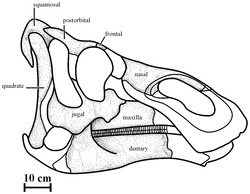


.png)
Newly named birds
| Name | Novelty | Status | Authors | Age | Unit | Location | Notes | Images | |
|---|---|---|---|---|---|---|---|---|---|
|
Sp. nov. |
Valid |
A Strigidae. |
|||||||
|
Sp. nov. |
Valid |
Middle Pleistocene |
An Accipitridae. |
||||||
|
Sp. nov. |
Valid |
Middle Miocene |
An Anatidae. |
||||||
|
Sp. nov. |
Valid |
Late Pliocene |
Middle Villafranchian |
An Alaudidae. |
|||||
|
Gen. nov. et Sp. nov. |
Valid |
Late Miocene. late Clarendonian |
|
An Accipitridae close in morphology to the Old World Vultures. The type species of the new genus. |
|||||
|
Sp. nov. |
Valid |
24-26 Ma |
An Anhingidae. |
||||||
|
Sp. nov. |
Valid |
Middle Miocene |
MN 7-8 |
A Motacillidae. |
|||||
|
Sp. nov. |
Valid |
Carmen Guerra |
Early Pleistocene |
Cave deposits |
A Strigidae. |
||||
|
Gen. nov. et Sp. nov. |
Valid |
Early Pliocene |
A Picidae, this is the type species of the new genus. |
||||||
|
Gen. nov. et Sp. nov. |
Valid |
|
A stem parrot, a member of Pan-Psittaciformes. The type species of the new genus. |
||||||
|
Gen. nov. et Sp. nov. |
Valid |
Early Miocene |
Originally described as a member of the family Scolopacidae or a relative of the Scolopacidae; De Pietri, Mayr & Scofield (2019) transferred this species to the family Glareolidae.[108] The type species of the new genus. |
||||||
|
Sp. nov. |
Valid |
Early Miocene |
|||||||
|
Gen. nov. et Sp. nov. |
Valid |
A Hesperornithiformes Fürbringer, 1888, Brodavidae Martin, Kurochkin et Tokaryk, 2012, this is the type species of the new genus. |
|||||||
|
Sp. nov. |
Valid |
|
A Hesperornithiformes Fürbringer, 1888, Brodavidae Martin, Kurochkin et Tokaryk, 2012. |
||||||
|
Sp. nov. |
Valid |
A Hesperornithiformes Fürbringer, 1888, Brodavidae Martin, Kurochkin et Tokaryk, 2012. |
|||||||
|
Sp. nov. |
Valid |
Late Miocene |
Originally described as a species of Certhia; Zelenkov (2017) transferred this species to a new genus Sylvosimadaravis within the superfamily Sylvioidea.[110] |
||||||
|
Gen. nov. et Sp. nov. |
Valid |
Middle Miocene |
An Anatidae, this is the type species of the new genus. |
||||||
|
Sp. nov. |
Valid |
Early Miocene |
A Cinclidae. |
||||||
|
Sp. nov. |
Valid |
Late Miocene |
An Accipitridae. |
||||||
|
Sp. nov. |
Valid |
Miocene (Santacrucian) |
A Tinamidae. |
||||||
|
Sp. nov. |
Valid |
Early Miocene |
A Scolopacidae, possibly a species of Elorius. |
||||||
|
Sp. nov. |
Valid |
Early Miocene |
An Emberizidae. |
||||||
|
Gen. nov. et Sp. nov. |
Valid |
Late Miocene |
An Alaudidae, this is the type species of the new genus. |
||||||
|
Sp. nov. |
Valid |
Late Pliocene |
Middle Villafranchian, |
An Alaudidae. |
|||||
|
Sp. nov. |
Valid |
Middle Miocene |
MN 7/8 |
A Muscicapidae, an Erithacus robin. |
|||||
|
Sp. nov. |
Valid |
Late Pliocene |
Middle Villafranchian |
An Alaudidae. |
|||||
|
Sp. nov. |
Valid |
Early Miocene |
An Alaudidae. |
||||||
|
Gen. nov. et Comb. nov. |
Valid |
Late Miocene |
An Anatidae a new genus for "Heterochen" vicinus Kurochkin, 1976. |
||||||
|
Sp. nov. |
Valid |
Late Pliocene |
A Hirundinidae. |
||||||
|
Sp. nov. |
Valid |
Early Aptian |
A Jeholornithidae Zhou et Zhang, 2006. |
||||||
|
Sp. nov. |
Valid |
A Spheniscidae. |
|||||||
|
Gen. nov. et Sp. nov |
Valid |
Late Whaingaroan or Early Duntroonian |
A Spheniscidae, the type species of the genus. |
||||||
|
Sp. nov. |
Valid |
Middle Miocene |
MN 7-8 |
A Laniidae. |
|||||
|
Sp. nov. |
Not valid |
Middle Pleistocene |
Cave deposits |
A Ciconiidae, the name is not valid because of the "ü" in it, that must, of course be a plain "u". |
|||||
|
Sp. nov. |
Valid |
Late Pliocene |
Middle Villafranchian |
An Alaudidae. |
|||||
|
Sp. nov. |
Valid |
Middle Miocene |
MN 7/8 |
An Alaudidae. |
|||||
|
Sp. nov. |
Valid |
Late Pliocene |
Early Late Villafranchian, |
||||||
|
Sp. nov. |
Valid |
Early Miocene |
A Muscicapidae. |
||||||
|
Gen. nov. et Sp. nov. |
Valid |
Middle Eocene |
Early Lutetian |
A Pelagornithidae, this is the type species of the new genus. |
|||||
|
Sp. nov. |
Valid |
Late Pliocene |
Middle Villafranchian |
An Alaudidae. |
|||||
|
Sp. nov. |
Valid |
Late Miocene |
Middle Late Pontian |
An Alaudidae. |
|||||
|
Gen. nov. et Sp. nov. |
Valid |
An Anatidae, this is the type species of the new genus, the new genus also contains "Anas" velox Milne-Edwards, 1868 as a Comb. nov. from France, Germany, Romania and ?Hungary. |
|||||||
|
Sp. nov. |
Valid |
Middle Miocene |
MN 7/8 |
A Muscicapidae. |
|||||
|
Sp. nov. |
Valid |
A Strigidae. |
|||||||
|
Gen. nov. et Sp. nov. |
Valid |
Early Miocene |
A Scolopacidae, the new genus is erected for the species "Tringa" gracilis Milne-Edwards, 1868, the type species of the new genus and makes a Com. nov. with it; genus may also contain this new species. |
||||||
|
Sp. nov. |
Valid |
Middle Miocene |
MN 6-8 |
||||||
|
Gen. nov. et Sp. nov. |
Valid |
Early Oligocene |
A stem group representative of the Piciformes, placed in a new family Picavidae Mayr et Gregorová, 2012. it is the type species of the new genus. |
||||||
|
Sp. nov. |
Valid |
Middle Pleistocene to Holocene |
Cave deposits |
A Passerellidae, towhee. |
|||||
|
Gen. nov. et Sp. nov |
Valid |
Late Pliocene |
Initially considered to be a likely close relative of longspurs, Calcariidae, and made the type species of the new genus Pliocalcarius; Palastrova & Zelenkov (2020) reinterpreted this species as a lark and transferred it to the genus Eremophila.[123] |
||||||
|
Gen. nov. et Sp. nov. |
Valid |
Middle Miocene |
MN 7/8 |
An Alaudidae. The type species of the new genus. |
|||||
|
Gen. nov. et Sp. nov. |
Valid |
A Columbidae related to the bronzewing pigeons. The type species of the new genus. |
|||||||
|
Sp. nov. |
Valid |
Late Miocene |
A Rheidae. Transferred to the genus Rhea by Tambussi, Degrange & De Mendoza (2023).[126] |
||||||
|
Sp. nov. |
Valid |
Early Miocene |
A Rallidae, a new species of Rallicrex Lambrecht, 1933, the type species is Rallicrex kolozsvarensis Lambrecht, 1933. |
||||||
|
Sp. nov. |
Valid |
Late Pliocene |
Originally described as a species of Rhodospiza; Palastrova & Zelenkov (2020) transferred it to the genus Emberiza.[128] |
||||||
|
Gen. nov. et Sp. nov. |
Valid |
Middle Eocene |
A Ciconiiformes Incertae Sedis. |
||||||
|
Gen. nov. et Sp. nov |
Valid |
A basal Ornithuromorpha. The type species of the new genus. |
|||||||
|
Gen. nov. et Comb. nov. |
Valid |
Early Miocene |
A Scolopacidae, a new genus for the species "Totanus" lartetianus, the type species of the genus, creating a Comb. nov. |
||||||
|
Gen. nov et Sp. nov. |
Valid |
Li Li Zhang Xi |
Early Cretaceous |
A Longipterygidae Zhang, Zhou, Hou L. H. et Gu, 2000, Enantiornithes Walker, 1981. The type species of the new genus. |
|||||
|
Sp. nov. |
Valid |
Early Eocene |
A Songziidae Hou, 1990, Gruiformes. The type species is Songzia heidangkouensis Hou, 1990. |
||||||
|
Sp. nov. |
Valid |
Late Miocene |
A Sturnidae. |
||||||
|
Sp. nov. |
Valid |
MN 7/8 |
An Anatidae. |
||||||
|
Sp. nov. |
Valid |
Early to Middle Miocene |
A Turdidae. |
||||||
|
Gen. nov. et Sp. nov. |
Valid |
Early Oligocene |
A Diomedeidae. The type species of the new genus. |
||||||
|
Gen. nov. et Sp. nov. |
Valid |
Early Cretaceous |
An Enantiornithes Walker, 1981. The type species of the new genus. |
||||||


