211 series
Japanese train type
From Wikipedia, the free encyclopedia
The 211 series (211系, 211-kei) is a suburban electric multiple unit (EMU) train type introduced in 1985 by Japanese National Railways (JNR).

| 211 series | |
|---|---|
 JR East 211 series set on a Joetsu Line service in January 2021 | |
| Manufacturers | |
| Replaced | 111 series, 113 series, 115 series |
| Constructed | 1985–1991 |
| Entered service | March 1986 |
| Scrapped | 2012– |
| Number built | 1,914 vehicles |
| Number in service | 849 vehicles (as of 2018) |
| Successor | 209 series, E233-3000 series, 315 series (from 2025) |
| Operators |
|
| Specifications | |
| Car body construction | Stainless steel Steel (JR West version) |
| Car length | 20,000 mm (65 ft 7 in) |
| Width | 2,966 mm (9 ft 8.8 in) |
| Doors | 3 pairs per side |
| Maximum speed |
|
| Traction system | Resistor control + field system superimposed field excitation control |
| Traction motors |
|
| Power output | 120 kW |
| Acceleration | 1.7 km/(h⋅s) (1.1 mph/s) |
| Electric systems | 1,500 V DC overhead catenary |
| Current collection | Pantograph |
| Bogies |
|
| Multiple working | 311/313 series |
| Track gauge | 1,067 mm (3 ft 6 in) |


The trains are still being used by East Japan Railway Company (JR East). They were also formerly used by West Japan Railway Company (JR West) until 2010 and Central Japan Railway Company (JR Central) until 2025 in Japan.
Sangi Railway will operate a total of eight former 211-5000 series 3-car sets (24 cars) with the first entering service in May, 2025,[1] and Ryutetsu acquired four 211-6000 series 2-car sets (8 cars) on 9 July, 2025.[2][3]
Design
The 211 series was developed by JNR to replace older 113 series and 115 series trains. The 211 series incorporated regenerative brakes and stainless steel body construction.
Variants
- 211-0 series (basic version with transverse seating)
- 211-1000 series (cold region version with transverse seating)
- 211-2000 series (basic version with all longitudinal seating)
- 211-3000 series (cold region version with all longitudinal seating)
- 211-5000 series (JR Central version)
- 211-6000 series (JR Central version with single motored car)
- Joyful Train variants (JR West version)
Operations
211-0, 211-2000 series
- Tōkaidō Main Line and Ito Line: Tokyo – Numazu/Ito (From 1986 - April 2012)
- Tōkaidō Main Line: Hamamatsu – Maibara
- Chūō Main Line: Tachikawa – Shiojiri
- Shinonoi Line: Shiojiri – Shinonoi
- Shinetsu Line: Shinonoi – Nagano
 211-0 series in original JNR livery in August 1988
 211-0 series in JR livery in December 2009
 211-0 series interior view, February 2010
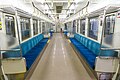 211-2000 series interior view, November 2021
 Green car seating, July 2010


211-1000, 211-3000 series
- Tohoku Main Line: Oyama – Utsunomiya[4]
- Takasaki Line: Ueno - Takasaki (1986 - March 2014)
- Ryomo Line: Takasaki – Oyama
- Shinetsu Line: Takasaki – Yokokawa
- Oito Line: Matsumoto –Shinano-Omachi
- Chuo Main Line: Takao[5] – Shiojiri/Shiojiri – Nakatsugawa
- Shinonoi Line: Shiojiri – Shinonoi
- Shinetsu Main Line: Shinonoi – Nagano
- Sobu Main Line: Chiba – Chōshi (via Yachimata) (21 October 2006 – 2012)[6][additional citation(s) needed]
- Narita Line: Chiba – Chōshi (via Narita) (21 October 2006 – 2012)[6][additional citation(s) needed]
- Kashima Line: Sawara – Kashima-Jingu (21 October 2006 – 2012)[6][additional citation(s) needed]
- Togane Line (since 21 October 2006 – 2012)[6][additional citation(s) needed]
- Uchibo Line: Chiba – Awa-Kamogawa (via Kisarazu) (21 October 2006 – 2012)[6][additional citation(s) needed]
- Sotobo Line: Chiba – Awa-Kamogawa (via Katsuura) (21 October 2006 – 2012)[6][additional citation(s) needed]
- Iida Line (since 15 March 2014)[7]
- Agatsuma Line (since 22 August 2016)[4]
- Joetsu Line: Takasaki - Minakami (since 23 August 2016)[4]
 211-3000 series with additional pantograph in March 2022
 211-3000 series in Nagano area livery in January 2022
 211-3000 series in Chiba area livery in May 2010
- 211-3000 series interior view, February 2022
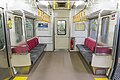 Priority seats, February 2022


211-5000, 211-6000 series
- Tokaido Main Line: Atami – Toyohashi
- Chuo Main Line: Nagoya – Nakatsugawa
- Kansai Main Line: Nagoya – Kameyama
- Gotemba Line: Kōzu – Numazu (until 2025)[8]
- Minobu Line: Fuji – Nishi-Fujinomiya
- Aichi Loop Line: Kozoji – Setoguchi
 211-5000 series in December 2019
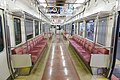 211-5000 series interior view, September 2021
 Priority seats, September 2021


Sangi Railway

On 20 and 22 March 2024, JR Central transferred five 211-5000 series 3-car sets to Sangi Railway.[9][10] On 10 March, 2025, they announced that they will operate a total of eight former 211-5000 series 3-car sets (24 cars).[1]
Ryutetsu
On 9 July, 2025, Ryutetsu announced that they had purchased four 211-6000 series 2-car sets GG5/GG6/GG8/GG9 (8 cars) from JR Central. The trains will be refurbished before entering service to replace their current 5000 series (former Seibu New 101 series) trains.[2][3][11]
Joyful Train sets
- Super Saloon Yumeji: Three-car set converted from 211 and 213 series coaches which entered service in 1988 and withdrawn in March 2010. Operated by JR-West and based at Okayama Depot.
 Super Saloon Yumeji in 1990
 Joyful Train 211 series in JR-West Livery in January 1989
 Interior view, September 2003


