5-simplex
Regular 5-polytope
From Wikipedia, the free encyclopedia
In five-dimensional geometry, a 5-simplex is a self-dual regular 5-polytope. It has six vertices, 15 edges, 20 triangle faces, 15 tetrahedral cells, and 6 5-cell facets. It has a dihedral angle of cos−1(1/5), or approximately 78.46°.
| 5-simplex Hexateron (hix) | ||
|---|---|---|
| Type | uniform 5-polytope | |
| Schläfli symbol | {34} | |
| Coxeter diagram |    | |
| 4-faces | 6 | 6 {3,3,3}  |
| Cells | 15 | 15 {3,3}  |
| Faces | 20 | 20 {3}  |
| Edges | 15 | |
| Vertices | 6 | |
| Vertex figure |  5-cell | |
| Coxeter group | A5, [34], order 720 | |
| Dual | self-dual | |
| Base point | (0,0,0,0,0,1) | |
| Circumradius | 0.645497 | |
| Properties | convex, isogonal regular, self-dual | |
The 5-simplex is a solution to the problem: Make 20 equilateral triangles using 15 matchsticks, where each side of every triangle is exactly one matchstick.
Alternate names
It can also be called a hexateron, or hexa-5-tope, as a 6-facetted polytope in 5-dimensions. The name hexateron is derived from hexa- for having six facets and teron (with ter- being a corruption of tetra-) for having four-dimensional facets.
By Jonathan Bowers, a hexateron is given the acronym hix.[1]
As a configuration
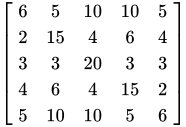
This configuration matrix represents the 5-simplex. The rows and columns correspond to vertices, edges, faces, cells and 4-faces. The diagonal numbers say how many of each element occur in the whole 5-simplex. The nondiagonal numbers say how many of the column's element occur in or at the row's element. This self-dual simplex's matrix is identical to its 180 degree rotation.[2][3]
Regular hexateron cartesian coordinates
The hexateron can be constructed from a 5-cell by adding a 6th vertex such that it is equidistant from all the other vertices of the 5-cell.
The Cartesian coordinates for the vertices of an origin-centered regular hexateron having edge length 2 are:
![{\displaystyle {\begin{aligned}&\left({\tfrac {1}{\sqrt {15}}},\ {\tfrac {1}{\sqrt {10}}},\ {\tfrac {1}{\sqrt {6}}},\ {\tfrac {1}{\sqrt {3}}},\ \pm 1\right)\\[5pt]&\left({\tfrac {1}{\sqrt {15}}},\ {\tfrac {1}{\sqrt {10}}},\ {\tfrac {1}{\sqrt {6}}},\ -{\tfrac {2}{\sqrt {3}}},\ 0\right)\\[5pt]&\left({\tfrac {1}{\sqrt {15}}},\ {\tfrac {1}{\sqrt {10}}},\ -{\tfrac {\sqrt {3}}{\sqrt {2}}},\ 0,\ 0\right)\\[5pt]&\left({\tfrac {1}{\sqrt {15}}},\ -{\tfrac {2{\sqrt {2}}}{\sqrt {5}}},\ 0,\ 0,\ 0\right)\\[5pt]&\left(-{\tfrac {\sqrt {5}}{\sqrt {3}}},\ 0,\ 0,\ 0,\ 0\right)\end{aligned}}}](http://wikimedia.org/api/rest_v1/media/math/render/svg/b79141ce810582c49e87824bc8b0f8a7ccec5d90)
The vertices of the 5-simplex can be more simply positioned on a hyperplane in 6-space as permutations of (0,0,0,0,0,1) or (0,1,1,1,1,1). These constructions can be seen as facets of the 6-orthoplex or rectified 6-cube respectively.
Projected images
| Ak Coxeter plane |
A5 | A4 |
|---|---|---|
| Graph |  |
 |
| Dihedral symmetry | [6] | [5] |
| Ak Coxeter plane |
A3 | A2 |
| Graph |  |
 |
| Dihedral symmetry | [4] | [3] |
 Stereographic projection 4D to 3D of Schlegel diagram 5D to 4D of hexateron. |
Lower symmetry forms
A lower symmetry form is a 5-cell pyramid {3,3,3}∨( ), with [3,3,3] symmetry order 120, constructed as a 5-cell base in a 4-space hyperplane, and an apex point above the hyperplane. The five sides of the pyramid are made of 5-cell cells. These are seen as vertex figures of truncated regular 6-polytopes, like a truncated 6-cube.
Another form is {3,3}∨{ }, with [3,3,2,1] symmetry order 48, the joining of an orthogonal digon and a tetrahedron, orthogonally offset, with all pairs of vertices connected between. Another form is {3}∨{3}, with [3,2,3,1] symmetry order 36, and extended symmetry [[3,2,3],1], order 72. It represents joining of 2 orthogonal triangles, orthogonally offset, with all pairs of vertices connected between.
The form { }∨{ }∨{ } has symmetry [2,2,1,1], order 8, extended by permuting 3 segments as [3[2,2],1] or [4,3,1,1], order 48.
These are seen in the vertex figures of bitruncated and tritruncated regular 6-polytopes, like a bitruncated 6-cube and a tritruncated 6-simplex. The edge labels here represent the types of face along that direction, and thus represent different edge lengths.
The vertex figure of the omnitruncated 5-simplex honeycomb, 


 , is a 5-simplex with a petrie polygon cycle of 5 long edges. Its symmetry is isomorphic to dihedral group Dih6 or simple rotation group [6,2]+, order 12.
| Join | {3,3,3}∨( ) | {3,3}∨{ } | {3}∨{3} | { }∨{ }∨{ } | |
|---|---|---|---|---|---|
| Symmetry | [3,3,3,1] Order 120 | [3,3,2,1] Order 48 | [[3,2,3],1] Order 72 | [3[2,2],1,1]=[4,3,1,1] Order 48 | ~[6] or ~[6,2]+ Order 12 |
| Diagram |  |
 |
 |
 |
 |
| Polytope | truncated 6-simplex   |
bitruncated 6-simplex |
tritruncated 6-simplex |
3-3-3 prism  |
Omnitruncated 5-simplex honeycomb |
Compound
The compound of two 5-simplexes in dual configurations can be seen in this A6 Coxeter plane projection, with a red and blue 5-simplex vertices and edges. This compound has [[3,3,3,3]] symmetry, order 1440. The intersection of these two 5-simplexes is a uniform birectified 5-simplex. =  ∩
∩  .
.

Related uniform 5-polytopes
It is first in a dimensional series of uniform polytopes and honeycombs, expressed by Coxeter as 13k series. A degenerate 4-dimensional case exists as 3-sphere tiling, a tetrahedral hosohedron.
 ,
,  ...
...


It is first in a dimensional series of uniform polytopes and honeycombs, expressed by Coxeter as 3k1 series. A degenerate 4-dimensional case exists as 3-sphere tiling, a tetrahedral dihedron.
, ...


The 5-simplex, as 220 polytope is first in dimensional series 22k.
 ...
...

The regular 5-simplex is one of 19 uniform polytera based on the [3,3,3,3] Coxeter group, all shown here in A5 Coxeter plane orthographic projections. (Vertices are colored by projection overlap order, red, orange, yellow, green, cyan, blue, purple having progressively more vertices)


